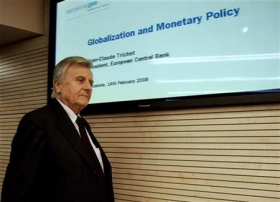
FRANKFURT (Reuters) - The European Central Bank kept euro zone interest rates unchanged at 4.0 percent on Thursday, and will publish updated economic forecasts which analysts will scrutinize for guidance on future monetary policy.
By Sakari Suoninen
FRANKFURT (Reuters) - The European Central Bank kept euro zone interest rates unchanged at 4.0 percent on Thursday, and will publish updated economic forecasts which analysts will scrutinize for guidance on future monetary policy.
ECB President Jean-Claude Trichet is due to comment on the competing threats of high euro zone inflation and slower growth at 1330 GMT when he holds his monthly news conference and delivers a quarterly update to the bank's economic projections.
All 72 economists polled by Reuters last week expected the ECB to keep rates on hold this month for a ninth month in a row <ECB/INT>, and the euro was little moved versus the dollar <EUR=>, despite hitting a record high of $1.5349 earlier in the day.
!ADVERTISEMENT!Economists expect ECB staff to forecast lower growth but higher inflation for this year and possibly for 2009, highlighting the Governing Council's dilemma as food and energy prices climb. It is not helped by the strong euro, which holds back inflation but also hampers growth.
Annual inflation in the 15-nation region hit a record high of 3.2 percent in January and February, dampening expectations that the ECB would soon follow other major central banks and loosen monetary policy.
Many economists believe the inflation projections will be revised up. BNP Paribas economist Ken Wattret said he expected the 2009 forecast to be raised to 1.9 or 2.0 percent from the current midpoint forecast of 1.8 percent.
A worsening inflation outlook would make it difficult for the ECB to justify lower interest rates, and mixed economic data and high uncertainty will color the discussion.
"This is a very difficult pass for the ECB president to navigate," Wattret said. "Priority number one is to avoid markets pricing in another rate cut and then being disappointed."
Economists expect the ECB staff to cut the growth forecast as consumer sentiment has weakened in several euro zone countries and the U.S. economic malaise is seen curbing exports.
"Growth would have to be revised down to 1.5 or 1.6 percent to trigger a rate cut," said UniCredit economist Aurelio Maccario. "I don't expect that, I think it will come down to 1.8 percent."
Earlier on Thursday European trade union body ETUC said that the euro's rise threatened jobs and said the ECB needed to cut rates urgently. Employer lobby BusinessEurope said that while some its members might welcome a rate cut, others were worried about inflation.
UNCERTAINTY STILL HIGH
Economists expect Trichet to comment on the uncertainty of the economic outlook. "The ECB will stress again there is uncommonly high uncertainty in the economy," Maccario said. He added this makes it more difficult for the ECB to give guidance on future rates.
Bank of America economist Holger Schmieding said there has probably been discussion in the Governing Council of whether the inflation or growth outlook is more worrisome, and in which direction the next rate move should be. "You could make a case for all three options ... I think there will be those who will advocate the next move should be a hike," he said.
The ECB has resisted following the United States, Canada and Britain in cutting rates because of price pressures in the euro zone. The Bank of England also left rates unchanged on Thursday but the gap with U.S. rates contributed to the euro breaking the $1.50 barrier for the first time last week, and the ECB's preferred trade-weighed index <EUREER=ECBF> is also at record highs.
Most economists expect the ECB to lower rates to 3.75 percent by the end of June, which would be the first cut in nearly five years, and again by the end of the year to 3.5 percent.
Economists will watch whether the Governing Council comments on foreign exchange rates. Trichet stressed on Monday the importance of the U.S. commitment to a strong dollar, helping to brake the dollar's slide.
In November Trichet said "brutal" currency moves are never welcome, but stopped short of stronger verbal intervention.
A Reuters poll of currency strategists showed renewed verbal intervention was seen as more likely than concerted central bank action to support the dollar. <EUR/POLL>
"He has to say something about abrupt moves," Wattret said. "If he says nothing that gives a green light to further appreciation of the euro."
The ECB has not intervened in currency markets since late 2000, action which followed an 11 percent fall in the trade-weighted euro in 10 months. In the last 10 months the euro has risen about 5 percent on a trade-weighted basis, although appreciation against the dollar has been sharper at about 12 percent.
(Additional reporting by David Milliken and Krista Hughes; editing by David Stamp))