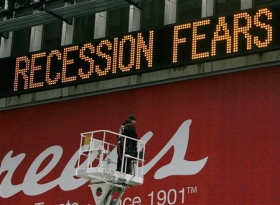
DAVOS, Switzerland (Reuters) - Confidence among leaders of the world's top companies has fallen for the first time in five years, with the specter of global recession now the single biggest factor keeping executives awake at night.
By Ben Hirschler
DAVOS, Switzerland (Reuters) - Confidence among leaders of the world's top companies has fallen for the first time in five years, with the specter of global recession now the single biggest factor keeping executives awake at night.
The findings underline the somber mood as movers and shakers meet in Davos this week for the annual meeting of the World Economic Forum, which will be dominated by the effects of the global credit crunch and its threat to the broader economy.
The gloom is deepest in North America, where just 35 percent of chief executives are "very confident" of growing revenues over the next 12 months, down from 53 percent a year ago, according to a survey by consultant PricewaterhouseCoopers <PWC.UL> (PwC) released on Tuesday.
!ADVERTISEMENT!Western European CEOs are also downbeat, with confidence levels falling to 44 percent, against 52 percent last year.
But the pessimism is not universal.
Many heads of emerging market companies are actually more upbeat about prospects, particularly in China and India where confidence rates have risen to 73 percent and 90 percent respectively.
"It is a tale of two worlds. You've got a clear erosion of confidence in the much of the developed world and a really high level of confidence in the emerging economies," Samuel DiPiazza, PwC's global CEO, told Reuters.
"In the newly emerged economies CEO confidence remains strong, perhaps because they have experienced nothing but rapid expansion for a decade or more."
The continued buoyant mood in Asia, Latin America and eastern Europe means there was only a 2 percentage point decline in global confidence levels, with exactly half the 1,150 CEOs surveyed still believing strongly in higher revenues.
The survey was conducted during the last quarter of 2007 but DiPiazza said sampling in recent weeks suggested there had not been a significant change in mood.
CLIMATE PUSHED ASIDE
In the past, CEOs have consistently named over-regulation as the top risk to their businesses but, for the first time in the 11-year history of the survey, recession fears now loom largest.
Other issues have been pushed to the sidelines, with climate change rated a concern by only 34 percent of respondents and worries about regulatory burdens, such as Sarbanes-Oxley regulations in the United States, also receding.
The picture is mixed on M&A prospects, with more CEOs believing the short-term outlook now hinges on developing existing markets rather than expanding through acquisitions.
Interest in deal-making is highest in Asia, where a band of increasingly powerful emerging market companies are flexing their financial muscles.
The rise of emerging market multinationals was also highlighted in another report from rival consultancy group Accenture.
"Today, 70 of the top 500 companies are emerging market multinationals. Ten years ago it w