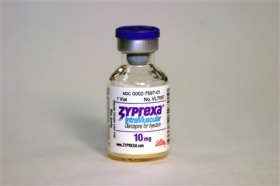
WASHINGTON (Reuters) - Excessive sedation is a serious concern following injections of a long-acting form of Eli Lilly and Co's Zyprexa schizophrenia medicine, U.S. drug reviewers said in an analysis released on Monday.
By Lisa Richwine
WASHINGTON (Reuters) - Excessive sedation is a serious concern following injections of a long-acting form of Eli Lilly and Co's Zyprexa schizophrenia medicine, U.S. drug reviewers said in an analysis released on Monday.
The experimental formulation, called Zyprexa Adhera, was shown to be effective for acute and long-term treatment of schizophrenia, U.S. Food and Drug Administration staff said.
The agency will ask an advisory panel that meets Wednesday if it finds the formulation effective and "acceptably safe."
!ADVERTISEMENT!"Excessive sedation events are a serious safety concern because of the severity of excessive sedation, the unpredictable characteristics, and relatively high incidence," FDA staff said in a preliminary analysis prepared for the panel meeting.
The rate was about 1.3 percent of patients, or 24 out of 1,915 who were treated with the drug, the FDA analysis said.
Lilly said the formulation provided important benefits that outweighed the sedation risk.
Zyprexa is Lilly's top-selling drug with nearly $4.8 billion in 2007 sales. The company currently sells it in pill form and as a short-acting injection.
The long-acting form could reach $1 billion in annual sales if approved, Natixis Bleichroeder analyst Jon LeCroy said.
"Their pipeline is not very deep right now, and so it does have some importance," LeCroy said.
The "sometimes profound" sedation seen in Lilly's studies generally occurred within one to three hours, FDA staff said. Two of the 25 cases were reported as "coma," while some others were described as "deep sleep" and "unarousable for hours."
All patients fully recovered within three to 72 hours, FDA reviewers said. Injections were given every two or four weeks.
Lilly, in a separate summary, said "although there are important additional safety considerations associated with the injection, they are manageable with appropriate labeling and risk-minimization activities."
Schizophrenia is a chronic mental illness that impairs the ability to think clearly, relate to others and distinguish between reality and fantasy. More than 2 million Americans have schizophrenia, according to National Institute of Mental Health estimates.
As many as 65 percent of schizophrenics do not take their medicines as prescribed, which can lead to a relapse, Lilly said. A long-acting injection could provide an option to keep patients on therapy, the company said.
"Many patients have decided that the risks are offset by robust symptom improvement, ensured medication delivery and flexibility in the dose," Lilly said.
FDA staff said they would ask the advisory panel if Zyprexa Adhera needed a strong "black-box" warning if approved, or if it should be designated a second-choice drug.
The FDA will consider input from the panel, a group of outside experts, before deciding whether to approve the drug. The agency usually follows panel recommendations.
Analyst LeCroy said the formulation was "probably still an approvable product" even with the sedation risk because it would be targeted to "a very sick patient population" that has trouble taking oral versions regularly.
Known generically as olanzapine, Zyprexa is part of the class known as atypical antipsychotics that were introduced in the 1990s. Zyprexa Adhera would compete with Johnson & Johnson's long-acting schizophrenia injection called Risperdal Consta.
Lilly shares rose 65 cents or 1.5 percent to $52.31 in afternoon trading on the New York Stock Exchange.
The FDA staff and Lilly summaries were posted on the agency's Web site at: http://www.fda.gov/ohrms/dockets/ac/08/briefing/2008-4338b1-00-- index.htm.
(Reporting by Lisa Richwine, editing by Gerald E. McCormick, Leslie Gevirtz)