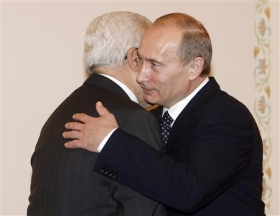
NOVO-OGARYOVO, Russia (Reuters) - Palestinian President Mahmoud Abbas told Russian President Vladimir Putin on Friday he was optimistic about a Middle East peace summit proposed by Moscow, but Washington struck a more cautious note.
By Conor Sweeney
NOVO-OGARYOVO, Russia (Reuters) - Palestinian President Mahmoud Abbas told Russian President Vladimir Putin on Friday he was optimistic about a Middle East peace summit proposed by Moscow, but Washington struck a more cautious note.
Russia, a mediator in the Middle East, sees the conference it wants to hold in Moscow as a follow-up to a meeting in the U.S. town of Annapolis in November that relaunched peace talks between Israel and the Palestinians.
"We believe the Moscow conference will be successful and help to achieve progress towards the Middle East settlement," Abbas told Putin at the start of their meeting at the Russian leader's residence in Novo-Ogaryovo outside Moscow.
!ADVERTISEMENT!Putin, who arrived in Novo-Ogaryovo from meeting Italy's Prime Minister-elect Silvio Berlusconi in Sardinia earlier on Friday, warmly greeted Abbas.
"You have come at a difficult moment and the situation is difficult. But we are certain that you and Israeli Prime Minister (Ehud) Olmert are making joint efforts to move forward with talks. We welcome and support that," he said.
Neither leader gave a date for the summit and as he flew out of Russia, Abbas told reporters no agreement on a date had been reached, Russian news agencies reported.
The U.S. State Department struck a cautious note. "There's no agreement on a date, or the particular agenda of the conference," a spokesman said.
Olmert had earlier signaled reluctance to attend a Middle East summit proposed by Russia, but did not entirely rule it out.
Russia, along with the United States, the European Union and the United Nations, is part of the so-called Quartet which is acting as a mediator in the Middle East peace process.
Newly confident as it enjoys an economic resurgence fuelled largely by oil exports, Russia is seeking to re-establish itself as a major player in the Middle East and wants to take a more prominent role in mediation efforts.
Russian diplomats believe they can use their ties to states in the region such as Iran and Syria -- with which other mediators have little contact -- to broker a deal.
Russian officials said in March the Moscow peace conference would try and restart talks between Israel and Syria about the occupied Golan Heights.
Peace talks between Israel and Syria fell through in 2000 over the extent of a proposed Israeli withdrawal from the Golan, a strategic plateau Israel occupied in the 1967 Middle East war.
Speaking at a Moscow airport before he flew away, Abbas said his administration did not want the United States to dictate who takes part in the Moscow conference, Russian agencies reported.
"We do not want the United States to apply pressure. We want the U.S. position to be coordinated with international organizations, and not be a substitute for them," Itar-Tass news agency quoted Abbas as saying.
(Additional reporting by Susan Cornwell in Washington; Writing by Dmitry Solovyov; Editing by Richard Meares)