
Hurricane response crews from the U.S. Geological Survey are installing storm-tide sensors at key locations along Florida’s southeast and southwest coastlines in advance of Hurricane Irma.
Under a mission assignment from the Federal Emergency Management Agency, the USGS is currently deploying approximately 58 storm tide sensors, 24 barometers and five rapid deployment gauges, and is consulting with federal and state partners about the need for similar equipment for other coastal areas farther north along the coastlines.
>> Read the Full Article

Packing tiny solar cells together, like micro-lenses in the compound eye of an insect, could pave the way to a new generation of advanced photovoltaics, say Stanford University scientists.
In a new study, the Stanford team used the insect-inspired design to protect a fragile photovoltaic material called perovskite from deteriorating when exposed to heat, moisture or mechanical stress. The results are published in the journal Energy & Environmental Science (E&ES).
>> Read the Full Article
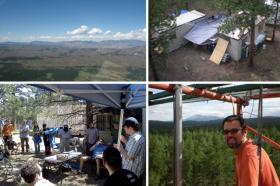
For a few weeks over the summer in 2011, teams of scientists from around the world converged on a small patch of ponderosa pine forest in Colorado to carry out one of the most detailed, extended survey of atmospheric chemistry ever attempted in one place, in many cases using new measurement devices created especially for this project. Now, after years of analysis, their comprehensive synthesis of the findings have been released this week.
>> Read the Full Article

Monarch butterfly populations from western North America have declined far more dramatically than was previously known and face a greater risk of extinction than eastern monarchs, according to a new study in the journal Biological Conservation.
“Western monarchs are faring worse than their eastern counterparts,” said Cheryl Schultz, an associate professor at Washington State University Vancouver and lead author of the study. “In the 1980s, 10 million monarchs spent the winter in coastal California. Today there are barely 300,000.”
>> Read the Full Article

IBM and MIT today announced that IBM plans to make a 10-year, $240 million investment to create the MIT–IBM Watson AI Lab in partnership with MIT. The lab will carry out fundamental artificial intelligence (AI) research and seek to propel scientific breakthroughs that unlock the potential of AI. The collaboration aims to advance AI hardware, software, and algorithms related to deep learning and other areas; increase AI’s impact on industries, such as health care and cybersecurity; and explore the economic and ethical implications of AI on society. IBM’s $240 million investment in the lab will support research by IBM and MIT scientists.
>> Read the Full Article