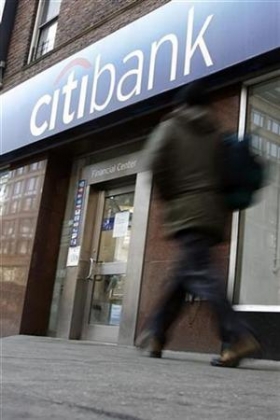
BANGALORE (Reuters) - Since the start of the month, Wall Street analysts have forecast first-quarter losses at Citigroup <C.N> and Merrill Lynch <MER.N> and slashed their earnings estimates for several other U.S. banks on expectations of further write-downs on the back of challenging global capital markets.
By Neha Singh and Tenzin Pema
BANGALORE (Reuters) - Since the start of the month, Wall Street analysts have forecast first-quarter losses at Citigroup <C.N> and Merrill Lynch <MER.N> and slashed their earnings estimates for several other U.S. banks on expectations of further write-downs on the back of challenging global capital markets.
"After a kitchen-sink fourth quarter, first quarter of 2008 is likely to be another very weak quarter due to further large loan loss reserve build, higher credit losses, weak fee income, weak loan growth, and decline in net-interest-margins at several banks," JP Morgan analyst Vivek Juneja wrote in a research note.
Analysts are predicting sizable first-quarter write-downs at U.S. financial institutions, with Citigroup taking the maximum write-downs on its collateralized debt obligations and subprime exposures.
!ADVERTISEMENT!Citigroup is expected to suffer write-downs in the range of $8 billion to about $16 billion.
Net write-downs at Merrill Lynch are seen in the range of $3 billion to $5 billion.
"If our forecasts are correct, it is likely that these firms (Citigroup and Merrill) may need to raise additional capital in coming months via equity offerings, asset sales and/or dividend cuts," Goldman Sachs analyst William Tanona wrote in an April 1 research note.
However, Lehman Brothers analyst Jack Malvey, in a fixed income research note issued on Friday, said he expects write-downs to slow at global financial institutions after the first quarter.
He said, "Himalaya-like guestimates, ranging from $600 billion to $1.2 trillion, seem highly improbable," for 2008.
The worst scares for financial institution stability may have passed in March, but riskier markets such as stocks and junk bonds may have further to drop, Malvey said.
In the last several months, banks have written off more than $160 billion for debt and credit losses, even as the U.S. Federal Reserve has slashed interest rates and made it easier for lenders and investment banks to borrow in an attempt to bolster market liquidity.
"The challenge for the large banks is the amount of reserve build partly due to uncertainty about extent of economic weakness and how much losses will rise," JP Morgan analyst Juneja said.
Banks that do not build large reserves in the first quarter may have large additions throughout the rest of 2008, he said.
Last week, Goldman Sachs Group Inc <GS.N>, Lehman Brothers Holdings Inc <LEH.N> and Morgan Stanley <MS.N> posted better-than-expected first quarter results, easing investor worries.
Morgan Stanley overall had the best quarter among the big Wall Street banks, suffering the smallest year-over-year profit drop.
The S&P Financial Index <.GSPF> was down 1.32 points to 357.29 in afternoon trade. Shares of Citigroup were trading down nearly 1 percent to $24.20 on the New York Stock Exchange.
(Editing by Jarshad Kakkrakandy)