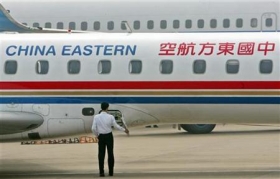
SHANGHAI/HONG KONG (Reuters) - China Eastern Airlines <0670.HK> shareholders rejected a deal to sell a 24 percent stake to Singapore Airlines <SIAL.SI> for US$920 million, opening the door for bigger rival Air China <0753.HK> to make a play for the country's third-largest carrier.
By Fang Yan and Joanne Chiu
SHANGHAI/HONG KONG (Reuters) - China Eastern Airlines <0670.HK> shareholders rejected a deal to sell a 24 percent stake to Singapore Airlines <SIAL.SI> for US$920 million, opening the door for bigger rival Air China <0753.HK> to make a play for the country's third-largest carrier.
The collapse of a deal two years in the making and blessed by Beijing highlights the unpredictability of a Chinese corporate scene that usually bows to politics, and marks a shift in how minority shareholders influence control of a large company.
Analysts say loss-making China Eastern, squeezed by record fuel prices, would try and return to the negotiating table with Singapore Air and its parent Temasek <TEM.UL> to try and get a better deal. A less favored option would be to submit to the Air China group's advances.
!ADVERTISEMENT!"This is a significant coup" for Air China, said Andrew Au at Cazenove. "This is critical in turning around China Eastern as it would give the group the power to radically restructure management, which has been the root cause of the carrier's problems over the past few years."
Singapore Airlines, the world's most profitable airline, had hoped to gain access via the acquisition to a travel arena that's expanding as increasingly wealthy Chinese take to the skies.
It said in a statement it was disappointed but would continue to build a relationship with China Eastern.
Analysts say China Eastern needs capital to relieve some of the burden of net gearing of 1,500 percent as it battles Air China and China Southern <1055.HK> <ZNH.N> <600029.SS>.
Cathay Pacific <0293.HK>, which already has an alliance with Air China, bolstered its partner's bid by saying this week it would consider teaming up on a joint investment in China Eastern.
"There's not much difference between domestic airlines in terms of management expertise and branding," a combative-sounding China Eastern Chairman Li Fenghua told reporters.
"In this case, one and one would not equal more than two."
BOISTEROUS
Wednesday's closely watched vote by China Eastern's minority shareholders turned into one of the most boisterous stockholder meetings of the past year, as more than 100 shareholders and executives squeezed into a downtown Shanghai hotel conference room to argue their case.
Shareholders often interrupted each other and one incensed woman tried to force her way onto the podium.
Many said they liked Air China's higher bid.
Its parent, China National Aviation Corp (CNAC), has said it will submit a rival bid for China Eastern within two weeks, offering at least HK$5 per share against the HK$3.80 agreed last year with Singapore.
"Air China seems committed to making a higher bid. But Singapore would have brought a lot of international management expertise to China Eastern," said Kelvin Lau, analyst at Daiwa Institute of Research.
CNAC, which owns 3.9 percent of China Eastern <600115.SS> <CEA.N> but which has more than 12 percent of its Hong Kong stock, had argued for weeks that the sale to Singapore was being done on the cheap -- a perennial worry among domestic investors fearing a fire-sale of Chinese assets to foreign firms.
Shares in China Eastern and Singapore Airlines were suspended on Tuesday, pending the vote. Air China ended the day down 3 percent as investors cashed out of its recent rally. Traders said shares in China Eastern and Air China were likely to dip on Wednesday as investors flee uncertainty.
The battle over an airline that has made losses in three of the past five years underscores the lure of an industry dominated by three players but which is growing at more than 16 percent a year ahead of this summer's Beijing Olympic Games.
Analysts say Air China also feared the creation of a strong competitor based in the commercial hub of Shanghai -- where Air China is traditionally weak.
Singapore Air and China Eastern insisted their agreed deal was fair at six times the airline's end-2006 book value.
Analysts said investors may now favor a tie-up between China Eastern and Air China, the world's most valuable airline by market capitalization, especially if Cathay gets on board.
Others said Singapore Airlines and Temasek could be persuaded to return to the table with a sweetened bid.
"With the deal vetoed, SIA's out of the picture for the time being. Obviously, that's a positive for both Cathay Pacific and Air China -- less competition," said CLSA analyst Adrian Lowe.
"My sense is they'll probably give up, given how things have played out, (but) some minority shareholders from China Eastern are hoping for a bidding war."
(Additional reporting by Joseph Chaney, Alison Leung, Tony Munroe, Tom Miles in HONG KONG, Andrew Torchia in SHANGHAI and Kevin Lim and Saeed Azhar in SINGAPORE; writing by Edwin Chan; editing by Anne Marie Roantree & Ian Geoghegan)