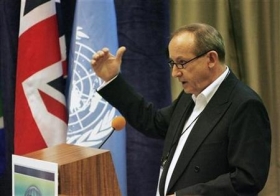
BEIJING (Reuters) - The top U.N. official on climate change said on Thursday that he sees a U.S. plan to cap rising emissions by 2025 as only a "first offer," adding that all three presidential candidates had promised a tougher stand.
By Emma Graham-Harrison
BEIJING (Reuters) - The top U.N. official on climate change said on Thursday that he sees a U.S. plan to cap rising emissions by 2025 as only a "first offer," adding that all three presidential candidates had promised a tougher stand.
Yvo de Boer, head of the U.N. Climate Change Secretariat, also said that as the fight against climate change gets more urgent, the world will have to embrace nuclear power and provide more support to developing nations.
"I see this very much as a first offer from the United States," he told journalists when asked whether the proposal unveiled last week by current President George W. Bush might discourage China from taking faster action on emissions.
!ADVERTISEMENT!"The three presidential candidates ... all have climate change high up on their agenda and I'm confident that after the elections we will have an ambitious U.S. stance."
De Boer also backed nuclear power, which emits no greenhouse gasses but is rejected by some environmentalists.
"If you look at the scale of the challenge I find it very difficult to conceive how we can get to grips with it unless nuclear energy has a role," he said during a visit to the Chinese capital for a forum on science and technology.
China's top climate change official, Vice-Minister Xie Zhenhua, called at the start of the meeting for an international technology transfer fund to ease poorer nations' transition to a less carbon-intensive economy.
"Developing countries lack advanced technology for tackling climate change, so developed countries, for the benefit of the planet, should take tangible measures to remove barriers to technology transfer," Xie said in a speech.
"Technology innovation and transfer must be comprehensive."
China is already the world's number two producer of carbon dioxide and its annual emissions may have overtaken those of the United States last year.
But its leaders say the country has low historic and per capita emissions, and needs help from the west to curb its output while ensuring it can continue to fight poverty.
De Boer backed Xie's stance but also said China had to work harder to ensure that proactive government policies aimed at promoting renewable energy and greater efficiency were carried out at grassroots level.
"China, like most countries, is really struggling to meet the targets it has set itself in terms of climate change," he said.
"The challenge really is to find a way that will allow China to engage further without jeopardizing the goals of poverty eradication and economic growth...the international community will have to put in technological and financial incentives."
China has already benefited massively from the U.N.'s clean development mechanism (CDM) which allows rich nation polluters to fund emissions cuts in developing nations in return for credits they can put towards domestic quotas.
The Asian giant last year cornered the largest chunk of the market. But de Boer said Beijing was pouring even more of its own money into emissions-cutting projects and added international solutions to warming must include policy as well as market tools.
(Reporting by Emma Graham-Harrison; Editing by Nick Macfie)