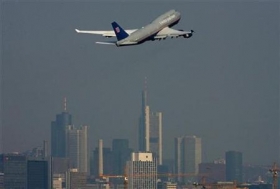
WASHINGTON/CHICAGO (Reuters) - United Airlines seems to be the prime mover in the next industry merger, and a decision could come soon as carriers are forced to consolidate for survival.
By John Crawley and Kyle Peterson
WASHINGTON/CHICAGO (Reuters) - United Airlines seems to be the prime mover in the next industry merger, and a decision could come soon as carriers are forced to consolidate for survival.
Now that a proposal for Delta Air Lines <DAL.N> to swallow Northwest Airlines <NWA.N> is under U.S. antitrust review with good prospects for approval, according to several experts, attention has shifted to United and its talks with US Airways Group Inc <LCC.N> and Continental Airlines Inc <CAL.N>.
"Something's going to happen. You're looking at a carrier that's sinking fast," said consultant Michael Boyd, a critic of United management. "I've become convinced that United probably has to merge."
!ADVERTISEMENT!For the first time, all the major carriers, according to industry sources, are in play for possible mergers or stronger marketing alliances.
Delta and Northwest announced their deal on April 14. Sources briefed on the situation have said American Airlines <AMR.N> has had early stage discussions with US Airways and is in advanced talks for an alliance with Continental.
Sources have also said Continental is in talks with United on a merger and would choose either a deal with United or an alliance with American, but not both.
Industry sources with knowledge of the matter said last week that merger discussions between United and US Airways were heating up and that United soon would make a decision.
Talk of consolidation has become increasingly prominent in recent months as skyrocketing fuel prices and a weak U.S. economy threaten to throw airlines into a deeper tailspin. Industry leaders believe mergers can save costs by reducing capacity and generating more revenue.
Airline consultant Robert Mann, for example, said shrinking the playing field would make it easier for carriers to raise fares. Kevin Mitchell, chairman of the Business Travel Coalition, agreed, saying "merged mega airlines" will "fortify their hubs" and hoard gates and slots to thwart competition.
Some experts believe that UAL, whose first-quarter loss of $537 million was the largest by a major carrier, has the most to lose by not joining another airline.
United Chief Executive Glenn Tilton has been a consolidation proponent, having shepherded the carrier through bankruptcy and seeing its stock slump since it reemerged in February 2006.
"Oil at over $110 a barrel does not alone make the case for consolidation in this industry," Tilton said on an analyst call last week.
"It simply makes it more compelling, as does increased foreign competition and a softening economy," he said. "At United we're well positioned to participate to the benefit of all of our stakeholders."
US Airways CEO Doug Parker is also a merger proponent, but no big airlines have confirmed any talks.
POSSIBLE COMBINATIONS
UAL's market cap stands at $1.8 billion while Continental's is $1.69 billion. US Airways' stock has had the steepest slide over the past year, falling 84 percent from over $45 to $7.16 at Friday's close. Marketcap at US Airways is the lowest among major carriers in the merger mix at $657 million.
A United-US Airways deal foundered in 2001 on antitrust concerns. But consolidation proponents say the industry and the two carriers have changed dramatically.
Both have restructured hubs and routes during long stays in bankruptcy, and United has slashed domestic capacity to focus more on international routes. US Airways merged in 2005 with America West Airlines.
Analysts have said a United-US Airways deal would be less complex than a merger with Continental. United and US Airways are part of the same global marketing alliance and United would gain a stronger foothold in the eastern United States.
United's top nonstop routes serve its Chicago hub as well as hubs in Denver, San Francisco and Los Angeles. US Airways
is strongest in Charlotte, Boston, Washington and New York LaGuardia. Government figures show the two would combine to hold about 17 percent of U.S. market share, based on traffic.
Continental, based in Houston, would give United instant presence in Texas -- to better compete with American and Southwest Airlines <LUV.N>.
United also would gain more New York-area muscle and premier access to international service. Continental controls more than half the market at New Jersey's Newark Airport.
The two combined would command about 19 percent of domestic service, based on revenue passenger miles.
(Additional reporting by Jui Chakravorty Das; by Richard Chang)