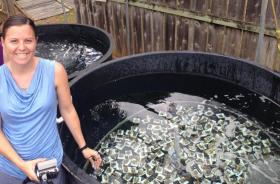
The newest professor in the University of Rhode Island’s College of the Environment and Life Sciences, Hollie Putnam, thinks some corals and shellfish might have good enough “memories” to buffer the changes in ocean chemistry that are resulting from global climate change.
A native of Minnesota who earned a doctorate at the University of Hawaii, Putnam is studying how a wide variety of marine organisms are responding to changes in their environment. Focusing on reef-building corals and other shelled creatures that are threatened by increasing temperatures and ocean acidification, she is testing them to determine how species may acclimatize to the new circumstances.
>> Read the Full Article
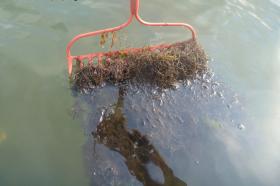
A new model released this week by UConn ecologist Jamie Vaudrey pinpoints sources of nitrogen pollution along Long Island Sound, and shows municipalities what they might do to alleviate it. Vaudrey presented her research Feb. 19 at the AAAS annual meeting in Boston.
Long Island Sound is an estuary of the Atlantic Ocean bordered by Connecticut to the north, New York City to the west, and Long Island to the south. The Sound is home to dozens of species of birds, 170 species of fish, and more than 1,200 species of invertebrates. Historically it has supported rich recreational and commercial fisheries for lobster, oysters, blue crabs, scallops, striped bass, flounder, and bluefish.
>> Read the Full Article

Since 1980, populations of warm-dwelling species in Germany have increased. The trend is particularly strong among warm-dwelling terrestrial species, as shown by the most comprehensive study across ecosystems in this regard to date. The most obvious increases occurred among warm-dwelling birds, butterflies, beetles, soil organisms and lichens according to the study published recently in the scientific journal “Nature Ecology & Evolution” led by Senckenberg scientists. Thus, it appears possible that rising temperatures due to the climate change have had a widespread impact on the population trends of animals in the past 30 years.
>> Read the Full Article
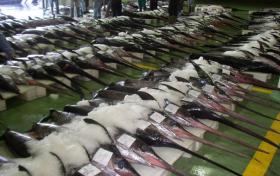
Researchers from the University of Burgos (Spain) have developed a fluorescent polymer that lights up in contact with mercury that may be present in fish. High levels of the metal were detected in samples of swordfish and tuna. According to the conclusions of another Spanish study, mercury exposure is linked to reduced foetal and placental growth in pregnant women.
The presence of the toxic metal mercury in the environment comes from natural sources, however, in the last decades industrial waste has caused an increase in concentrations of the metal in some areas of the sea. In the food chain, mercury can be diluted either in organic form as methylmercury (MeHg+) or as an inorganic salt, the cation Hg2+.
>> Read the Full Article

As a result of climate change, concentrations of the trace element selenium in soils are likely to decrease. Because the selenium content of crops may also be reduced, the risk of selenium deficiency could be increased in many regions of the world. This was shown by a recent study which used data-mining to model the global distribution of selenium.
Selenium is an essential micronutrient obtained from dietary sources such as cereals. The selenium content of foodstuffs largely depends on concentrations in the soil: previous studies have shown that low selenium concentrations are associated with high pH and oxygen availability and low clay and soil organic carbon content. In Europe, as is known from regional studies, selenium-poor soils are found particularly in Germany, Denmark, Scotland, Finland and certain Balkan countries.
>> Read the Full Article



