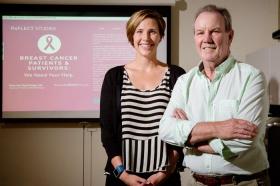
A new study indicates that cancer patients and survivors have a ready weapon against fatigue and “chemo brain”: a brisk walk.
Researchers at the University of Illinois, along with collaborators at Digital Artefacts in Iowa City, Iowa, and Northeastern University in Boston, looked at the association between physical activity, fatigue and performance on cognitive tasks in nearly 300 breast cancer survivors.
>> Read the Full Article
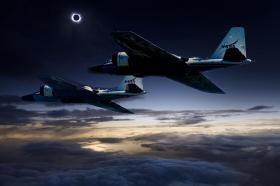
For most viewers, the Aug. 21, 2017, total solar eclipse will last less than two and half minutes. But for one team of NASA-funded scientists, the eclipse will last over seven minutes. Their secret? Following the shadow of the Moon in two retrofitted WB-57F jet planes.
>> Read the Full Article

A young, fit US soldier is marching in a Middle Eastern desert, under a blazing summer sun. He’s wearing insulated clothing and lugging more than 100 pounds of gear, and thus sweating profusely as his body attempts to regulate the heat. But it’s 108 degrees out and humid, too much for him bear. The brain is one of the first organs affected by heat, so his judgment becomes impaired; he does not recognize the severity of his situation. Just as his organs begin to fail, he passes out. His internal temperature is in excess of 106 degrees when he dies.
>> Read the Full Article

New research is challenging the age-old adage that money can’t buy happiness.
The study, led by researchers at the University of British Columbia and Harvard Business School, suggests that using money to buy free time— such as paying to delegate household chores like cleaning and cooking— is linked to greater life satisfaction.
>> Read the Full Article
Turbulence, the violently unruly disturbance of plasma, can prevent plasma from growing hot enough to fuel fusion reactions. Long a puzzling concern of researchers has been the impact on turbulence of atoms recycled from the walls of tokamaks that confine the plasma. These atoms are neutral, meaning that they have no charge and are thus unaffected by the tokamak’s magnetic field or plasma turbulence, unlike the electrons and ions — or atomic nuclei — in the plasma. Yet, experiments have suggested that the neutral atoms may be significantly enhancing the edge plasma turbulence, hence the theoretical interest in their effects.
>> Read the Full Article



