
Top Stories

Whether bold or shy, seal personalities are steady over time

Female seals don’t change their spots, according to a new study by University of Alberta biologists. In fact, individual differences in boldness remain consistent over time.

>> Read the Full Article

Path to zero emissions starts out easy, but gets steep

Carbon dioxide emissions from human activities must approach zero within several decades to avoid risking grave damage from the effects of climate change.  This will require creativity and innovation, because some types of industrial sources of atmospheric carbon lack affordable emissions-free substitutes, according to a new paper in Science from team of experts led by University of California Irvine’s Steven Davis and Carnegie’s Ken Caldeira.

>> Read the Full Article

NASA Finds Depression Strengthening into Tropical Storm Emilia

The Global Precipitation Measurement mission or GPM core satellite passed over Tropical Depression Six-E in the Eastern Pacific Ocean and found heavy rainfall occurring in two areas. Shortly after GPM passed overhead, the depression strengthened into Tropical Storm Emilia.

>> Read the Full Article

NASA Observes the Formation of Tropical Depression 09W in Northwestern Pacific

NASA's Aqua satellite passed over the Northwestern Pacific Ocean early on June 28 and caught an image of newly formed Tropical Depression 09W.

>> Read the Full Article

Territory Holders and Floaters: Two Spatial Tactics of Male Cheetahs

Scientists of the Leibniz Institute for Zoo and Wildlife Research (Leibniz IZW) in Berlin analysed the spatial behaviour of cheetahs. They showed that male cheetahs operate two space use tactics which are associated with different life-history stages. This long-term study on movement data of over 160 free-ranging cheetahs in Namibia has now been published in the scientific journal ECOSPHERE.

>> Read the Full Article

Major Study Reveals Great Barrier Reef’s 30,000-Year Fight for Survival

A landmark international study, recently published in Nature Geoscience, shows that the Great Barrier Reef has suffered 5 death events in the last 30,000 years. The groundbreaking study of the world’s largest reef system, involving the participation of Juan Carlos Braga Alarcón, a Full Professor at the UGR’s Department of Stratigraphy and Palaeontology, reveals that these events were driven mostly by variations in sea level and associated environmental changes. 

>> Read the Full Article
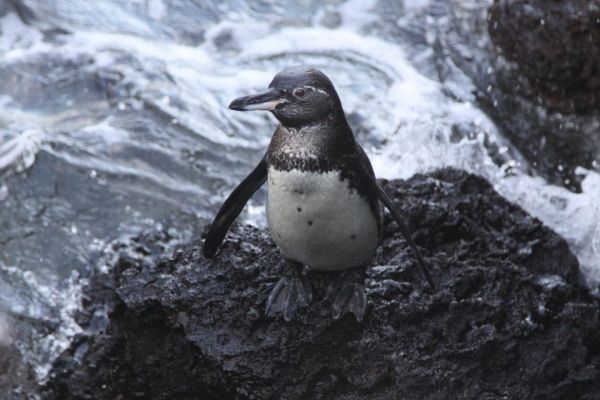
To Tell the Sex of a Galápagos Penguin, Measure its Beak, Researchers Say

It turns out that to tell the sex of a Galápagos penguin, all you need is a ruler.

In a paper published April 5 in the journal Endangered Species Research, scientists at the University of Washington announced that, for a Galápagos penguin, beak size is nearly a perfect indicator of whether a bird is male or female. Armed with this knowledge, researchers could determine the sex of a bird quickly and accurately in the wild without taking a blood sample — speeding up field studies of this unusual and endangered seabird.

>> Read the Full Article

Climate Change Linked to Bee Decline

A new study from Northwestern University and the Chicago Botanic Garden has found that climate change may drive local extinction of mason bees in Arizona and other naturally warm climates.

>> Read the Full Article

How Smart Technology Gadgets Can Avoid Speed Limits

Speed limits apply not only to traffic. There are limitations on the control of light as well, in optical switches for internet traffic, for example. Physicists at Chalmers University of Technology now understand why it is not possible to increase the speed beyond a certain limit – and know the circumstances in which it is best to opt for a different route. 

>> Read the Full Article

Handwashing and House Cleaning May Protect Against Unhealthy Chemicals

Washing your hands and cleaning your house frequently may help to lower your contact with common flame-retardant chemicals, according to a new study by researchers at the Columbia Center for Children’s Environmental Health (CCCEH) at Columbia University’s Mailman School of Public Health. The study is the first to assess whether house cleaning and handwashing can effectively lower exposure to flame retardants. Results appear in the Journal of Exposure Science and Environmental Epidemiology.

>> Read the Full Article