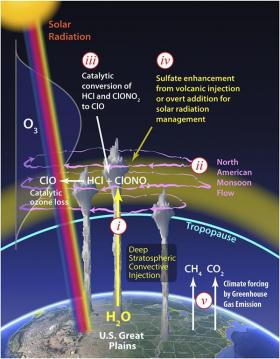
A new study out of Harvard University reveals that the protective stratospheric ozone layer above the central United States is vulnerable to erosion during the summer months from ozone-depleting chemical reactions, exposing people, livestock and crops to the harmful effects of UV radiation.
Powerful storm systems common to the Great Plains inject water vapor that, with observed temperature variations, can trigger the same chemical reactions over the central United States that are the cause of ozone loss over the polar regions, according to a new paper published in the Proceedings of the National Academy of Sciences.
>> Read the Full Article
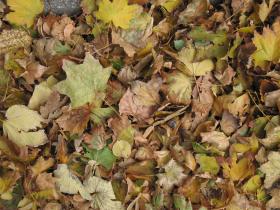
Michigan State University scientists have pinpointed a new source of nitrous oxide, a greenhouse gas that’s more potent than carbon dioxide. The culprit?
Tiny bits of decomposing leaves in soil.
This new discovery is featured in the current issue of Nature Geoscience, could help refine nitrous oxide emission predictions as well as guide future agriculture and soil management practices.
“Most nitrous oxide is produced within teaspoon-sized volumes of soil, and these so-called hot spots can emit a lot of nitrous oxide quickly,” said Sasha Kravchenko, MSU plant, soil and microbial scientist and lead author of the study. “But the reason for occurrence of these hot spots has mystified soil microbiologists since it was discovered several decades ago.”
>> Read the Full Article
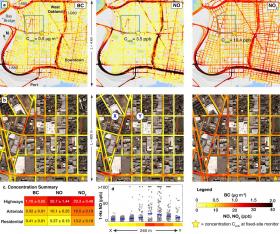
Engineering researchers at The University of Texas at Austin have developed the most detailed and extensive local map of air pollution ever produced for an urban area, using specially equipped Google Street View cars to measure air quality on a block-by-block basis. This new hyper-local mobile approach to measuring air quality, which reveals that air pollution can vary dramatically even within a single city block, could address major air quality monitoring gaps worldwide.
>> Read the Full Article

“Online technologies have transformed communications in practically every aspect of our lives, and now we’re seeing they’re also allowing patients to take an active role in their care and get immediate access to their care provider,” said ASCO Expert Harold J. Burstein, MD, PhD, FASCO. “It’s impressive that something as simple as this not only improves quality of life, but in this case, helps patients live longer. I think we’ll soon see more cancer centers and practices adopting this model.”
>> Read the Full Article
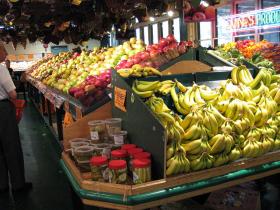
Research presented at the ASM Microbe 2017 meeting by Bryan Sanchez of California State University–Northridge in Northridge, Calif., show that antibiotic-resistant bacteria are present in many ready-to-eat foods such as fresh produce and dairy products and may serve as a source of human exposure to antibiotic-resistant bacteria. About 2 million people become infected with antibiotic resistant-bacteria annually in the United States, resulting in over $35 billion in additional health care costs. Examining potential ways that humans can be exposed to antibiotic-resistant bacteria can help in understanding how to counter the threat.
>> Read the Full Article
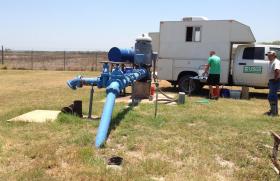
Decades or longer may be needed to fully assess the effects of unconventional oil and gas production on the quality of groundwater used for drinking water in Arkansas, Louisiana, and Texas
A new U.S. Geological Survey study shows that unconventional oil and gas production in some areas of Arkansas, Louisiana, and Texas is not currently a significant source of methane or benzene to drinking water wells. These production areas include the Eagle Ford, Fayetteville, and Haynesville shale formations, which are some of the largest sources of natural gas in the country and have trillions of cubic feet of gas.
>> Read the Full Article

Simon Fraser University researchers are investigating why some older Canadians living with multiple chronic health conditions maintain their resiliency.
Professor Andrew Wister, director of SFU’s Gerontology Research Centre, is SFU’s principal investigator for the multi-university Canadian Longitudinal Study on Aging (CLSA). He leads one of 25 research teams benefiting from a share of $1.7 million in CLSA catalyst grants, funded by the Canadian Institutes of Health Research (CIHR), announced today.
>> Read the Full Article



