
It's been nearly a year since Elon Musk revealed his intention to electrify the world’s roads with buses and trucks in addition to Tesla’s passenger cars. He hasn’t said much about the 18-wheeler—a proper unveil is set for September—except that it will use same motors as the upcoming Model 3, and that it would, of course, disrupt an industry that generates one quarter of US transportation-related greenhouse gas emissions.
>> Read the Full Article
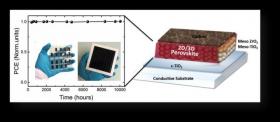
Perovskite solar cells promise cheaper and efficient solar energy, with enormous potential for commercialization. But even though they have been shown to achieve over 22% power-conversion efficiency, their operational stability still fails market requirements. Despite a number of proposed solutions in fabrication technology, this issue has continued to undercut whatever incremental increases in efficiency have been achieved. EPFL scientists have now built a low-cost, ultra-stable perovskite solar cell that has operated for more than a year without loss in performance (11.2%). The work is published in Nature Communications.
>> Read the Full Article

In August 2014, toxins from algal blooms in Lake Erie shut down the city of Toledo, Ohio’s water supply, leaving half a million residents without potable water for more than two days. A new study co-authored by UT researchers shows that a virus may have been involved in the crisis and suggests methods for more stringent monitoring of water supplies.
Steven Wilhelm, Kenneth and Blaire Mossman Professor of Microbiology, along with UT graduate students Joshua Stough and Lauren Krausfeldt, worked with a team of 25 researchers to examine the physiological traits of Microcystis, the cyanobacterial organism responsible for scum-like algal blooms in Lake Erie. They found that it was consistent with algal blooms from 2012 and 2013 except for one thing—the Microcystis cells had a viral infection. Typically, toxins from algal blooms are trapped within the cell until the cell dies. But virus infections can cause cells to break open, leaking the toxin into the water and subsequently into water facility intake pipes and treatment centers.
>> Read the Full Article



