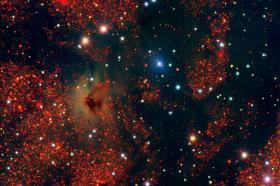
Consider that the Earth is just a giant cosmic dust bunny—a big bundle of debris amassed from exploded stars. We Earthlings are essentially just little clumps of stardust, too, albeit with very complex chemistry.
And because outer space is a very dusty place, that makes things very difficult for astronomers and astrophysicists who are trying to peer farther across the universe or deep into the center of our own galaxy to learn more about their structure, formation and evolution.
>> Read the Full Article
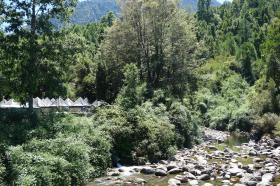
Tasty, versatile, and rich in essential omega-3 fatty acids: salmon is one of the most popular edible fish of all. Shops sell fish caught in the wild, but their main produce is salmon from breeding farms which can pollute rivers, lakes and oceans. Just how big is the problem? German and Chilean scientists are working to answer this question under the leadership of the Helmholtz Centre for Environmental Research (UFZ). They examined the dissolved organic compounds which enter Chile's rivers from salmon farms, and have published a report in the journal Scientific Reports, warning that these substances are placing huge strain on ecosystems and are changing entire biological communities.
>> Read the Full Article

Nearly 1,000 feet below the bed of the Dead Sea, scientists have found evidence that during past warm periods, the Mideast has suffered drought on scales never recorded by humans—a possible warning for current times. Thick layers of crystalline salt show that rainfall plummeted to as little as a fifth of modern levels some 120,000 years ago, and again about 10,000 years ago. Today, the region is drying again as climate warms, and scientists say it will get worse. The new findings may cause them to rethink how much worse, in this already thirsty and volatile part of the world.
>> Read the Full Article

With as many as 140 species, Atractus is the most diverse snake genus in the world, even though it can be found exclusively in Central and South America. However, these colubrid ground snakes seem largely under-researched, since there have been thirty-three species discovered in the last ten years only.
>> Read the Full Article

In a world where the demand for water continues to grow and the resource is finite, a new United Nations report argues that wastewater, discarded into the environment every day, once treated, can help meet the needs for freshwater as well as for raw materials for energy and agriculture.
>> Read the Full Article



