
The airline sector is trying to lessen its carbon footprint. In mid-June, the Paris Air Show will host the COP21 seen from the sky conference. Boeing and Airbus are concentrating their commercial efforts on the environment, which is now a selling point. “CO2 affects our ability to grow," said Jonathon Counsell, Head of Environment for British Airways, during a day dedicated to the environment organised by Airbus at its Toulouse site. Airlines make up 2% of worldwide CO2 emissions. But the doubling of passengers every 15 years has made it a growing source of greenhouse gases.
>> Read the Full Article

In what they believe to be the first survey of its kind in the United States, researchers at NYU Langone Medical Center have found that as many as 6 percent of adult New Yorkers who get "inked" -- in other words, those who get a tattoo -- have experienced some form of tattoo-related rash, severe itching or swelling that lasted longer than four months and, in some cases, for many years.
"We were rather alarmed at the high rate of reported chronic complications tied to getting a tattoo," says senior study investigator and NYU Langone dermatologist Marie Leger, MD, PhD, whose team's latest findings appear in the journal Contact Dermatitis online May 27.
>> Read the Full Article
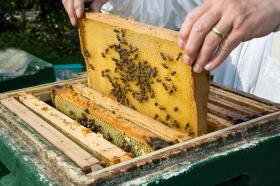
Biologists at UC San Diego have discovered that a tiny single-celled parasite may have a greater-than expected impact on honey bee colonies, which have been undergoing mysterious declines worldwide for the past decade. In this week’s issue of the journal PLOS ONE, the scientists report that a microsporidian called Nosema ceranae, which has been known to infect adult Asiatic and European honey bees, can also infect honeybee larvae.
>> Read the Full Article
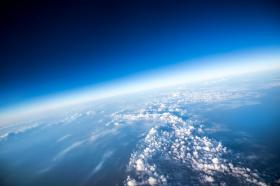
We are already reaping the rewards of the Montreal Protocol, with the ozone layer in much better shape than it would have been without the UN treaty, according to a new study in Nature Communications. Study lead author Professor Martyn Chipperfield, from the School of Earth & Environment at the University of Leeds, said: “Our research confirms the importance of the Montreal Protocol and shows that we have already had real benefits. We knew that it would save us from large ozone loss 'in the future', but in fact we are already past the point when things would have become noticeably worse.”
>> Read the Full Article

Two pennies can be considered the same -- both are pennies, just as two elephants can be considered the same, as both are elephants. Despite the vast difference between pennies and elephants, we easily notice the common relation of sameness that holds for both pairs.
Analogical ability -- the ability to see common relations between objects, events or ideas -- is a key skill that underlies human intelligence and differentiates humans from other apes.
>> Read the Full Article
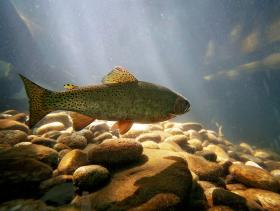
As snowpack levels decline with the warming climate, many streams will experience less water flow, especially during summer months, potentially exposing more fish to predation by birds and other animals. A new study has found that providing adequate shade and cover in small streams may reduce predation on trout by as much as 12 percent, from just one species of bird – the kingfisher.
>> Read the Full Article
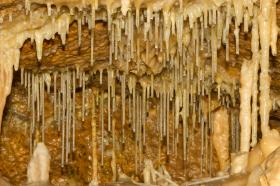
It turns out that the steady dripping of water deep underground can reveal a surprising amount of information about the constantly changing cycles of heat and cold, precipitation and drought in the turbulent atmosphere above. As water seeps down through the ground it picks up minerals, most commonly calcium carbonate. When this mineral-rich water drips into caves, it leaves mineral deposits behind that form layers which grow during wet periods and form dusty skins when the water dries up. Today, scientists can date these layers with extreme precision based on the radioactive decay of uranium into its daughter product thorium. Variations in the thickness of the layers is determined by a combination of the amount of water seeping into the cave and the concentration of carbon dioxide in the cave’s atmosphere so, when conditions are right, they can provide a measure of how the amount of precipitation above the cave varies over time. By analyzing the ratios of heavy to light isotopes of oxygen present in the layers, the researchers can track changes in the temperature at which the water originally condensed into droplets in the atmosphere changes and whether the rainfall’s point of origin was local or if traveled a long way before falling to the ground.
>> Read the Full Article
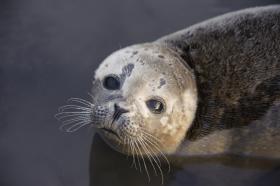
Wind farms may be a vital source of green energy, but new research shows that the construction of off-shore wind farms could potentially be damaging the hearing of harbour seals and other marine life. Researchers at St. Andrews University in Scotland believe that there is cause for concern that human building operations in our coastal waters, for example the pile driving process that hammers the foundation posts for wind turbines into the sea bed, could be damaging the hearing of marine mammals to an extent we hadn’t previously guessed at.
>> Read the Full Article

The European Parliament voted last week to re-assess the use of cadmium in TV sets sold across Europe, saying safer alternatives to the toxic and carcinogenic substance were now widely available.
Cadmium is widely used in illumination and display lighting applications such as LCD screens used in television sets or desktop computers.
>> Read the Full Article
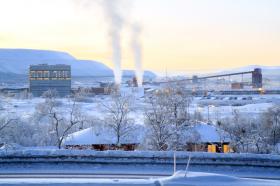
Have you ever just wanted to pick up and leave the foundation you call home? Kiruna knows the feeling.
Kiruna, a town in northern Sweden, built its riches upon the vast seam of iron ore, but the massive mine is now sinking the city of 23,000 residents. Now faced with a crisis, the town of Kiruna is moving to avoid catastrophe.
Northern Sweden is not the most welcoming place to build a city. With long, brutal winters and short, mild summers, Kiruna’s climate doesn’t exactly scream city material, but the iron resources that lie underneath it scream Mecca.
>> Read the Full Article



