
If scientists want the public to trust their research suggestions, they may want to appear a bit "warmer," according to a new review published by Princeton University's Woodrow Wilson School of Public and International Affairs.
The review, published in the Proceedings of the National Academy of Sciences (PNAS), shows that while Americans view scientists as competent, they are not entirely trusted. This may be because they are not perceived to be friendly or warm.
>> Read the Full Article
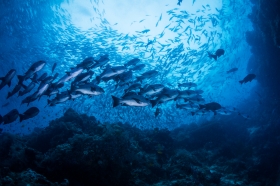
The cold waters of Earth's deep ocean have not warmed measurably since 2005, according to a new NASA study, leaving unsolved the mystery of why global warming appears to have slowed in recent years. Scientists at NASA's Jet Propulsion Laboratory in Pasadena, California, analyzed satellite and direct ocean temperature data from 2005 to 2013 and found the ocean abyss below 1.24 miles (1,995 meters) has not warmed measurably. Study coauthor Josh Willis of JPL said these findings do not throw suspicion on climate change itself.
>> Read the Full Article

Air pollution has had a significant impact on the amount of water flowing through many rivers in the northern hemisphere, according to the results of a new study. The paper shows how pollution, known as aerosols, can have an impact on the natural environment and highlights the importance of considering these factors in assessments of future climate change.
>> Read the Full Article
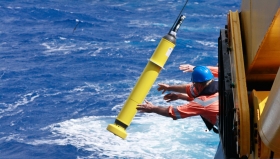
Using satellite observations and a large suite of climate models, Lawrence Livermore scientists have found that long-term ocean warming in the upper 700 meters of Southern Hemisphere oceans has likely been underestimated.
"This underestimation is a result of poor sampling prior to the last decade and limitations of the analysis methods that conservatively estimated temperature changes in data-€Âsparse regions," said LLNL oceanographer Paul Durack, lead author of a paper appearing in the October 5 issue of the journal Nature Climate Change.
>> Read the Full Article

The rusty-patched bumble bee (Bombus affinis), which has not been seen in the eastern United States in five years, has been found by a Smithsonian Conservation Biology Institute research team at Sky Meadows State Park in Delaplane, Va. This formerly common bee has disappeared from 87 percent of its range in the Upper Midwest and Eastern Seaboard and is feared headed for extinction.
The research team, led by Bill McShea and Tom Akre of the Smithsonian Conservation Biology Institute and T'ai Roulston from the University of Virginia, surveyed bee populations at 17 Virginia sites from May through August to study the influence of land management on bee diversity. Only one individual of this now rare species was found among nearly 35,000 bees belonging to 126 species collected and examined by the study.
>> Read the Full Article

The United States will commit to significantly improving developing countries' access to data, tools and training to help them adapt to climate change, the US president told the Climate Summit in New York last week (23 September). Barack Obama pledged to immediately release higher resolution topographical data for Africa, to scale up a training programme to boost meteorologists’ ability to monitor and predict climate change, and to create a public-private partnership to put climate-relevant information and tools in the hands of developing world policymakers.
>> Read the Full Article

The glaciers on Greenland are melting, and this is releasing visible plumes of sediments to surrounding waters. NASA has released some new images showing these plumes.
Toward the end of the 21st century, melting from the Greenland Ice Sheet could result in global sea level rise of 4-21 centimeters (2-8 inches), according to the Fifth Assessment Report from the Intergovernmental Panel on Climate Change. Toward refining that estimate, some scientists are taking a close look at the colorful plumes that pepper the ocean around Greenland's perimeter.
About half of the mass lost from the Greenland Ice Sheet is from icebergs calving from glaciers; the other half is lost via meltwater runoff either from the top of the ice or from below (subglacial). According to Vena Chu of University of California, Los Angeles, one of the biggest science questions relating to the ice sheet is: what is the contribution to sea level rise from meltwater?
>> Read the Full Article

It's official: California is now the first state in the country to institute a statewide plastic bag ban! Though it took years for state legislators to pass this bill plus an additional month that felt like an eternity for the governor to sign the bill into law, environmentalists can finally rejoice in the knowledge that grocery store plastic bags will soon be a thing of the past. Analysts expect the legislation will eliminate at least 13 billion plastic bags per year. Don't expect to see a change immediately, however: the ban won't go into effect until next July. Liquor and convenience stores will have until July of 2016 to switch to paper or reusable bags.
>> Read the Full Article

A mass of thousands of walruses were spotted hauled up on land in northwest Alaska during NOAA aerial surveys earlier this week. An estimated 35,000 occupied a single beach – a record number illustrating a trend in an unnatural behavior scientists say is due to global warming. Walruses (Odobenus rosmarus)—iconic arctic mammals that are only distantly related to seals—traditionally use sea ice to rest, breed, and give birth, and as a vantage from which to spot mollusks and other food sources. However, as their habitat warms and sea ice melts, walruses are forced to come to land more often and in greater numbers.
>> Read the Full Article



