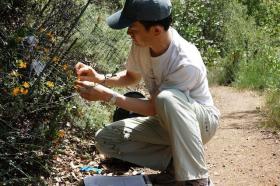
Dipping its beak into the sweet nectar of a flower, a hummingbird is doing more than getting a meal – it’s contributing to a microbial community that could potentially determine the fate of that flower. Recognizing that this fleeting interaction could have major implications on crop success and the health of pollinator species, the research group led by Tadashi Fukami, an associate professor of biology at Stanford, has studied the relationships between pollinators, microbes and plants for nearly a decade.
>> Read the Full Article
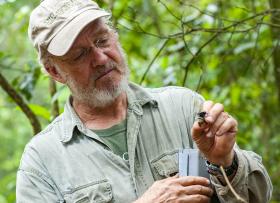
Areas in Latin America suitable for growing coffee face predicted declines of 73-88 percent by 2050. However, diversity in bee species may save the day, even if many species in cool highland regions are lost as the climate warms. The research, co-authored by David Roubik, senior scientist at the Smithsonian Tropical Research Institute, will be published in an early online Proceedings of the National Academy of Sciences edition between Sept. 11-15.
>> Read the Full Article
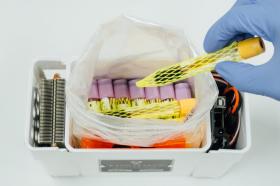
Johns Hopkins researchers have set a new delivery distance record for medical drones, successfully transporting human blood samples across 161 miles of Arizona desert. Throughout the three-hour flight, they report, the on-board payload system maintained temperature control, ensuring the samples were viable for laboratory analysis after landing.
>> Read the Full Article
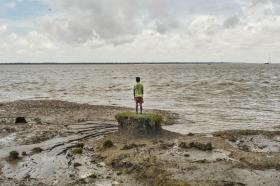
A century or two from now, people may look back at our current era — with its record-breaking high temperatures year after year, rapid disappearance of Arctic sea ice, and gradually rising sea levels — as part of a much cooler and far more desirable past. The spate of extreme weather events in the past month — which have devastated America’s fourth-largest city, Houston; spawned a massive hurricane that tore through the Caribbean and Florida; and swamped large swaths of India and Bangladesh — may well be a prelude to more monster hurricanes, Biblical rain events, and coastal inundations brought about by extreme weather and vastly higher sea levels.
>> Read the Full Article
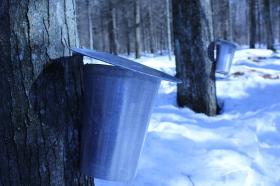
Maple syrup has been a Canadian staple for centuries and although many food-manufacturing processes have become automated, maple syrup is still largely made by small producers and bought from roadside stands and markets.
The Ontario Maple Syrup Producers Association (OMSPA), which represents more than 600 producers across the province, noticed there was a problem with this value chain. After receiving a large number of complaints about mould in maple syrup, OMSPA called in Carleton Chemistry Prof. David Miller — an expert on fungi and fungal toxins in food — to see if he could crack the sugary conundrum.
>> Read the Full Article

A Canadian effort to build one of the most innovative radio telescopes in the world will open the universe to a new dimension of scientific study. The Honourable Kirsty Duncan, Minister of Science, today installed the final piece of this new radio telescope, which will act as a time machine allowing scientists to create a three-dimensional map of the universe extending deep into space and time.
The Canadian Hydrogen Intensity Mapping Experiment, known as CHIME, is an extraordinarily powerful new telescope. The unique “half-pipe” telescope design and advanced computing power will help scientists better understand the three frontiers of modern astronomy: the history of the universe, the nature of distant stars and the detection of gravitational waves
>> Read the Full Article

Artificial-intelligence research has been transformed by machine-learning systems called neural networks, which learn how to perform tasks by analyzing huge volumes of training data.
During training, a neural net continually readjusts thousands of internal parameters until it can reliably perform some task, such as identifying objects in digital images or translating text from one language to another. But on their own, the final values of those parameters say very little about how the neural net does what it does.
>> Read the Full Article
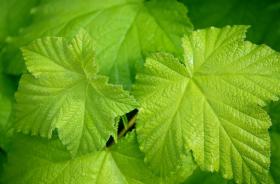
Researchers led by Scripps Institution of Oceanography at the University of California San Diego have determined that major changes in plant behavior have occurred over the past 40 years, using measurements of subtle changes in the carbon dioxide (CO2) currently found in the atmosphere.
The two main isotopes, or atomic forms, of carbon are carbon-12 (12C) and carbon-13 (13C). As CO2 has risen since the late 19th century, the ratio of 13C to 12C in atmospheric CO2 has decreased. That’s in part because the CO2 produced by the combustion of fossil fuels has a low 13C/12C ratio. There are other factors in nature as well, however, that have influenced the rate of decrease in the isotopic ratio. The measured rate of decrease in the isotopic ratio turns out to be different than what scientists previously expected.
>> Read the Full Article



