A paper appearing in Geophysical Research Letters uses machine learning to craft an improved model for understanding geothermal heat flux — heat emanating from the Earth’s interior — below the Greenland Ice Sheet. It’s a research approach new to glaciology that could lead to more accurate predictions for ice-mass loss and global sea-level rise.
A paper appearing in Geophysical Research Letters uses machine learning to craft an improved model for understanding geothermal heat flux — heat emanating from the Earth’s interior — below the Greenland Ice Sheet. It’s a research approach new to glaciology that could lead to more accurate predictions for ice-mass loss and global sea-level rise.
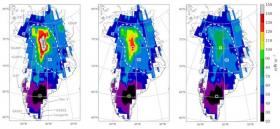
Greenland has an anomalously high heat flux in a relatively large northern region spreading from the interior to the east and west.
Southern Greenland has relatively low geothermal heat flux, corresponding with the extent of the North Atlantic Craton, a stable portion of one of the oldest extant continental crusts on the planet.
The research model predicts slightly elevated heat flux upstream of several fast-flowing glaciers in Greenland, including Jakobshavn Isbræ in the central-west, the fastest moving glacier on Earth.
Continue reading at University of Kansas
Image: This graphic shows geothermal heat flux predictions for Greenland. CREDIT: University of Kansas