

Researchers at Kyushu University report that they have developed a new method to more accurately analyze the distribution of small microplastics in the ocean at various depths.
Researchers at Kyushu University report that they have developed a new method to more accurately analyze the distribution of small microplastics in the ocean at various depths. Their findings showed that concentrations of small microplastics suspended in the ocean range from 1,000 to 10,000 particles per cubic meter. The team also discovered that small microplastics sink to the depths of the ocean in two distinct ways: some attain near-neutral buoyancy and drift at specific depths, while others sink rapidly to the deep sea.
Since the advent of plastic in the early 20th century, plastic waste and pollution have been a global issue. As plastics degrade, they break off into smaller pieces. When they reach less than 5 mm in size, they are called microplastics.
“When these microplastics degrade further to 10-300 µm, we call them small microplastics. Many researchers are investigating the distribution and movement of microplastics in the ocean. However, when they reach that size, they become harder to collect and analyze,” explains Professor Atsuhiko Isobe of Kyushu University Research Institute for Applied Mechanics and one of the researchers who led the study. “There was no standardized protocol to evaluate the presence of small microplastics in the ocean that could minimize contamination, particle loss, and potential fragmentation.”
Read more at: Kyushu University
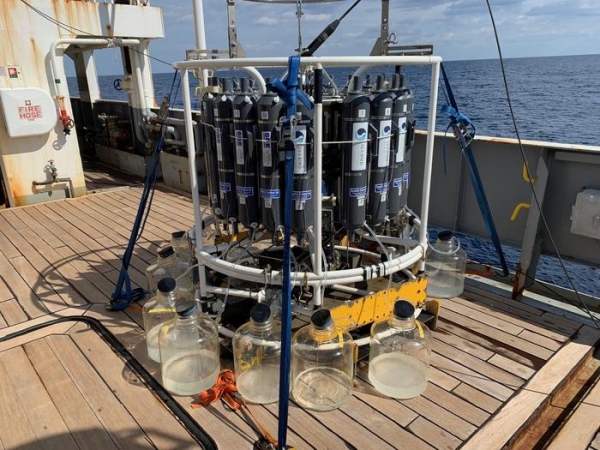
The multilayer water sampler that was installed on the training vessel Umitaka-maru. The device collects about 50 liters of seawater at different ocean depths, which is then analyzed for small microplastics. (Atsuhiko Isobe/Kyushu University)


