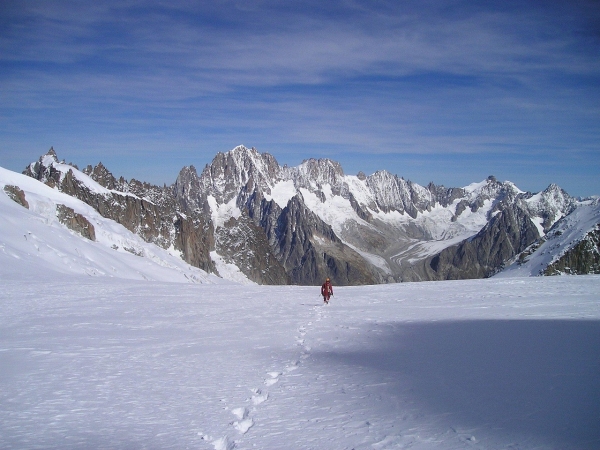
A recent study from Earth and Planetary Science Letters is the first to directly link earthquakes to climate change-induced glacial melt.
A recent study from Earth and Planetary Science Letters is the first to directly link earthquakes to climate change-induced glacial melt. Scientists analyzed 15 years of seismic activity in the Grandes Jorasses—a peak that is part of the Mont Blanc massif between Italy and France—to better understand this association. This massif is one of the more seismologically active areas in the region, and examining how climate change may affect earthquakes there could prove useful in preparing for them.
“Researchers had long observed seasonal fluctuations in earthquake activity and proposed several external drivers [as causes],” said Verena Simon, one of the lead authors of the study and a postdoctoral researcher at the Swiss Seismological Service. In an interview with GlacierHub, she explained that snow and ice load changes, intense rainfall and atmospheric-pressure changes have previously been proposed as triggers for seismic activity.
“Fluids of various types are very much involved in fault motions,” said John Mutter, a seismologist at Columbia University’s Lamont-Doherty Earth Observatory, which is part of the Columbia Climate School. “Where two chunks of rock meet one another, is a fault plane. That fault plane usually contains something called gouge, which is soft material that has been caused by the milling of one crystal rock against the other. If there is fluid in those gouge sediments, that facilitates the motion.”
Read More: Columbia Climate School
Photo Credit: Simon via Pixabay