

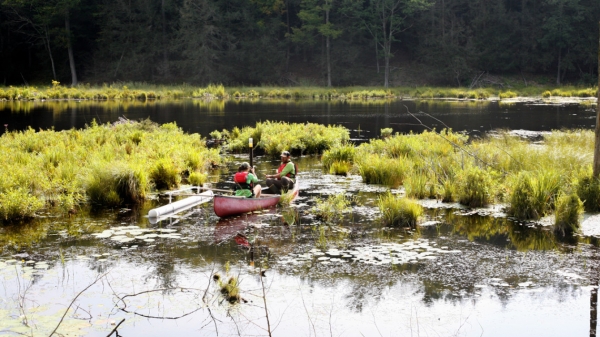
When Meredith Holgerson arrived at Cornell in 2020, she began searching for the perfect ponds.
When Meredith Holgerson arrived at Cornell in 2020, she began searching for the perfect ponds. Poring over maps, taking tips, she’d traipse into the woods of central New York with an inflatable kayak strapped to her back.
By 2021, she had found Mud Pond and Texas Hollow Pond, two bodies of water similar in size but different in key ways that would help her team understand why and how ponds – often understudied and overlooked in carbon budgeting – emit such a high volume of greenhouse gases.
Now a study of the two ponds, published Nov. 26 in Limnology & Oceanography, reveals surprising and complex mechanisms for how carbon dioxide and methane in ponds are built up, stored and released. The researchers found that Texas Hollow, while only a little over 1 meter deeper than Mud Pond, emitted more than twice the amount of carbon dioxide. They also examined how the ponds’ stratification – the extent to which the water forms layers of different temperatures – impacts methane emissions, finding that the ponds’ slight differences in depth and light led to unexpected results, with nearly twice as much methane bubbling up from the sediments of Mud Pond than Texas Hollow.
Read More: Cornell University
Image: Meredith Holgerson, associate professor of ecology and evolutionary biology in the College of Agriculture and Life Sciences, collects a sediment sample from Texas Hollow Pond in central New York. (Credit: Cornell University)


