Analysis of early direct images from James Webb telescope show immense dust clouds on brown dwarf that lead to a blurring of atmospheric lines—and scientific consensus.
Analysis of early direct images from James Webb telescope show immense dust clouds on brown dwarf that lead to a blurring of atmospheric lines—and scientific consensus.
In the first high-profile paper of a program to observe planets beyond our solar system with the James Webb Space Telescope (JWST), a team of scientists including Professor Xi Zhang at the University of California, Santa Cruz, have used direct imaging of a mysterious exoplanet to dispel a long-held assumption about the atmospheres of celestial objects of its size.
The exoplanet in question is known as VHS 1256b, in the constellation Corvus some 40 light-years from Earth. It is classified as a brown dwarf, which are enormous orbs sometimes called “super-Jupiters” when their mass hovers around that of the gas giant in our home system. As such, astronomers believed these kinds of exoplanets had atmospheres that swirled and variably shined in a similar fashion as Jupiter’s.
NASA selected VHS 1256b for close observation by the JWST Direct Imaging Early Release Science Program because its brightness in the infrared spectrum showed the largest variability detected on any exoplanet to date. The new findings seem to answer why VHS 1256b has been winking at astronomers so wildly.
Read More: University of California – Santa Cruz
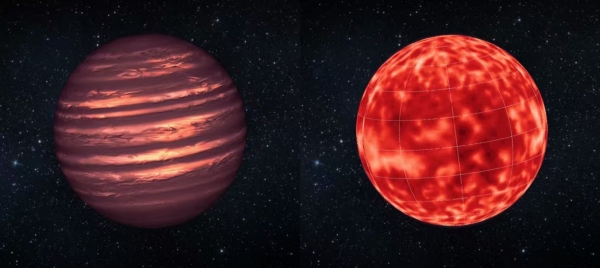
Image: Left: Artistic conception of the longheld astronomical assumption of brown dwarfs resembling Jupiter in appearance, displaying prominent multiple zonal bands and stable vortices similar to the Great Red Spot. (Credit: NASA/JPL-Caltech) Right: Study team’s modeled general circulation for super-Jupiter VHS 1256B.