A sediment core from Arizona’s Stoneman Lake provides an archive of dust emissions and pollen records in the region that extends through multiple ice ages.
A sediment core from Arizona’s Stoneman Lake provides an archive of dust emissions and pollen records in the region that extends through multiple ice ages.
Atmospheric dust plays an important role in the way Earth absorbs and reflects sunlight, impacting the global climate, cloud formation, and precipitation. Much of this dust comes from the continuous reshaping of Earth’s surface through the erosion of rocks and sediments, and understanding how this process has shaped landscapes can help us decipher our planet’s history – and its future. Although an ephemeral phenomenon by nature, dust emissions through time can be depicted through natural archives like lake sediment cores. In a new study, scientists examine one such record to peer 230,000 years into the past of the American Southwest. The region, they found, produced 1.2 to 10 times more dust between ice ages than during them, in contrast to other areas around the world. The findings can help scientists better predict how landscape disturbance, including by human activities, may contribute to atmospheric dust loads and alter future weather patterns.
The research, published Nov. 28th in the journal Nature Communications, was led by DRI scientist Spencer Staley. Staley examined a lake sediment core from Stoneman Lake, Arizona, that has been collecting atmospheric dust from around the Southwest for millennia. By quantifying the rate of dust deposition in the lake sediment, Staley and his team could observe dust processes of the entire region upwind of the site, offering a regional perspective on the historical landscape processes occurring at Earth’s surface.
“Stoneman Lake has been around for over a million years, and it’s been collecting sediment and recording paleo environments for that entire time,” Staley said. “In that region, a lake that’s been around that whole time, even during the drier periods, is kind of unheard of. It’s been recording history for a very long time.”
Read More: Desert Research Institute
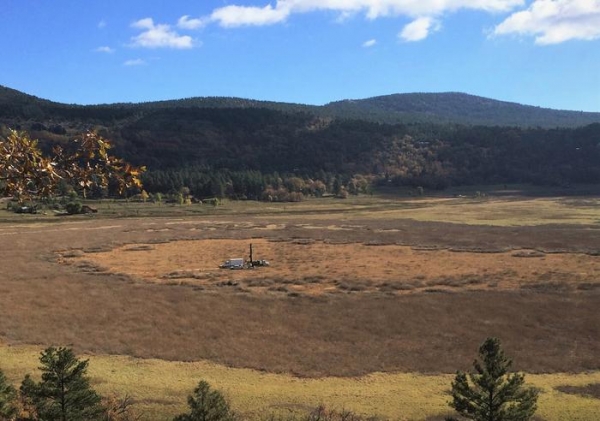
Image: The research team drilling the sediment core from Stoneman Lake, Arizona in 2014. Photo by Kevin Kelly.