If manganese nodules can be mined in an environmentally friendly way, the critical metals needed for the energy transition could be produced with low CO2 emissions.
If manganese nodules can be mined in an environmentally friendly way, the critical metals needed for the energy transition could be produced with low CO2 emissions.
The demand for metals will increase significantly in the coming years, primarily because the climate-friendly transformation of the economy is only possible through the electrification of industrial processes, transport and heat generation. By 2050, around 60 million tonnes of copper will be needed for electric motors and the expansion of the electricity grid. Moreover, depending on how battery technology develops, a further 10 million tonnes of nickel and 1.4 million tonnes of cobalt may also be required. Demand for copper and nickel would therefore more than double by the middle of the century, while demand for cobalt could increase fivefold. The extraction of metals always has a negative impact on the environment. Large areas of forest are repeatedly cleared for nickel and cobalt mining. And the mining of cobalt in particular often takes place under very questionable social conditions: according to UNICEF, children are often sent to work in the mines. The ores found on land also contain only a very small proportion of the metals sought. For every tonne of copper mined from deposits on land, some 200 tonnes of waste are produced, and taken together, the annual production of copper, nickel and cobalt generates between 4 and 5 billion tonnes of unusable rock and slag.
An alternative to land-based mining is the extraction of deep-sea ore nodules, commonly known as manganese nodules, which, besides large amounts of manganese, also contain a significant proportion of copper, nickel and cobalt. They are found in large quantities in the Clarion-Clipperton Zone in the Pacific. A team from the Max Planck Institute for Sustainable Materials has now presented an efficient and low-CO2 process in the journal Science Advances in which copper, nickel and cobalt can be extracted from deep-sea ore by smelting and reducing it with hydrogen. The method is significantly more sustainable than the process used by the Canadian company TMC for the reduction of deep-sea ores with carbon-based compounds in its Nori-D project. Using hydrogen for reduction cuts CO2 emissions by more than 90 per cent if green hydrogen and renewable electricity are used. The Max Planck team’s approach also requires almost 20 per cent less energy and fewer process steps.
Read More: Max Planck Institute for Sustainable Materials
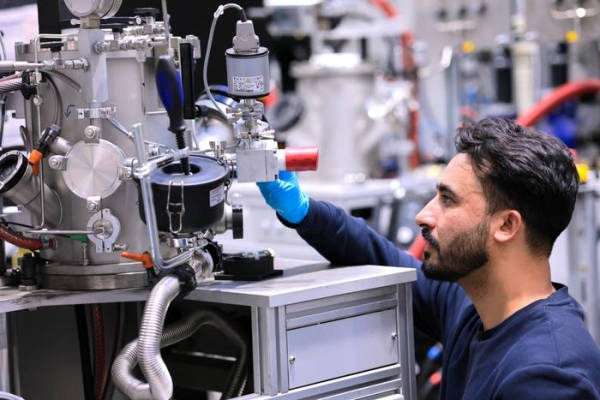
Image: Ubaid Manzoor adjusting the hydrogen partial pressure in the electric arc furnace to extract copper, nickel and cobalt from deep-sea polymetallic nodules. (Credit: Max Planck Institute for Sustainable Materials GmbH)