Researchers have shown that a 2022-2023 mass mortality event has driven previously abundant populations of Diadema africanum sea urchins throughout the Canary Islands to near-extinction.
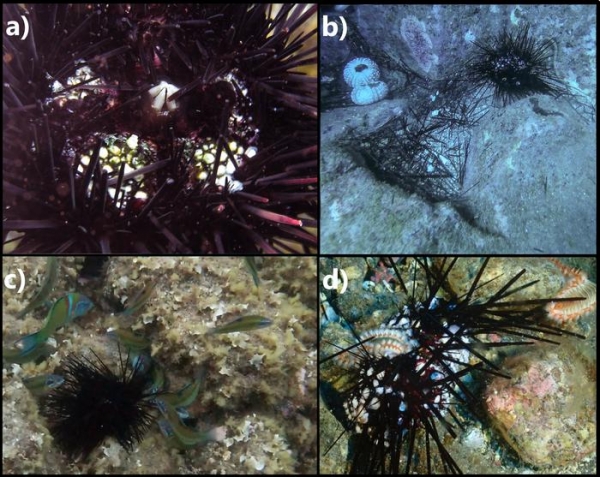
Researchers have shown that a 2022-2023 mass mortality event has driven previously abundant populations of Diadema africanum sea urchins throughout the Canary Islands to near-extinction. This outbreak was more impactful than previous ones in 2008 and 2018 in the same islands, because this time the production of larvae and the recruitment of juveniles has nearly ceased. The pathogens that caused the disease aren’t yet definitely known, but similar die-offs of sea urchins have been reported nearly simultaneously from the Caribbean to the western Indian Ocean.
Sea urchins are ecosystem engineers, the marine equivalent of mega-herbivores on land. By grazing and shredding seaweed and seagrass, they control algal growth and promote the survival of slow-growing organisms like corals and some calcifying algae. They are likewise prey for a plethora of marine mammals, fish, crustaceans, and sea stars. However, when they become overabundant, for example when these predators are overhunted or overfished, sea urchins can also inflict substantial damage to marine habits and form so-called ‘urchin barrens’."
Now, a study in Frontiers in Marine Science has revealed that over the last four years, an unrecognized pandemic that has been wiping out sea urchins around the world has hit the Canary Islands. The consequences on marine ecosystems aren’t yet fully known, but likely profound.
Read More: Frontiers
Image: Images of moribund D. africanum off Tenerife Island during the September 2022 mass mortality event: a) Moribund individual of D. africanum showing abnormal position and movement of the spines with white and greenish bare areas devoid of tissue; b) Accumulation of detached spines and dead D. africanum individuals on the sea bed; c) The fish Thalassoma pavo predating upon a moribund individual of D. africanum; and d) The polychaete Hermodice carunculata feeding on a dead individual of D. africanum. (Credit: Cano, Lorenzo-Morales, Bronstein, Sangil and Hernández)