Pollinator and fruit diversity on the globe’s smallholder farms – which account for up to 80% of all farms – remains strong, despite ecological fragmentation.
Pollinator and fruit diversity on the globe’s smallholder farms – which account for up to 80% of all farms – remains strong, despite ecological fragmentation. The findings could point to how to improve the industrialized farming pollinator crisis.
Industrial farming landscapes often have shortages of pollinators, which can cause production limitations for produce that needs them – and often lead to dire predictions (or at least online images of) supermarket produce sections empty of pollinator-dependent food.
This is largely due to unsustainable practices such as heavy pesticide use, the dependence on a handful of pollinator species, and long distances from natural areas where pollinators can live.
The story, however, on the globe’s smallholder farms, which account for 80% of all farms, appears different. Even though they are on often on fragmented landscapes that face similar sustainability challenges as industrial farms, new research suggests pollinator levels remain healthy – even if there are reasons for concern.
Read More: The Alliance of Bioversity International and the International Center for Tropical Agriculture
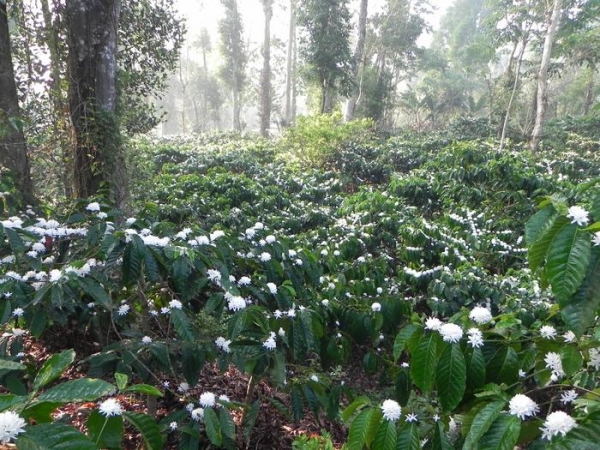
Image: In the upstream region of the Cauvery, India, adjacent to the riparian zone, coffee is extensively cultivated. This image captures the coffee inflorescence during its bloom phase. (Credit: Courtesy of Deepthi Narasimhaiah)