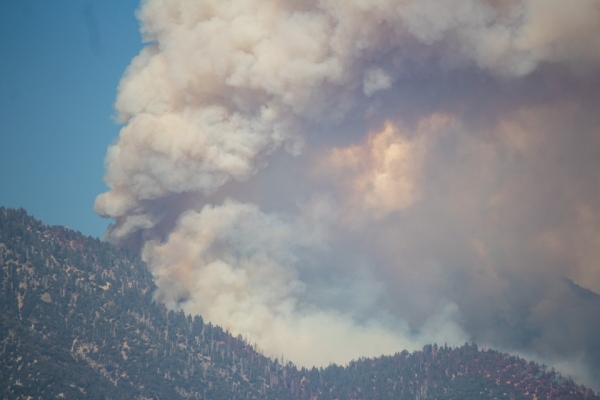
Across the western U.S., wildfires and the dangerous smoke that results have increased in frequency and intensity since the 1990s – that much is clear.
Across the western U.S., wildfires and the dangerous smoke that results have increased in frequency and intensity since the 1990s – that much is clear. Surprisingly less clear are the exact reasons why: While greenhouse gas-related global warming is often cited as a culprit, to what extent can this claim be quantified?
Atmospheric chemists and wildfire experts in the Harvard John A. Paulson School of Engineering and Applied Sciences (SEAS) have authored one of the most rigorous estimates to date of just how much of the fire damage and hazardous smoke of the last three decades is directly attributable to the warming temperatures and drier conditions caused by climate change.
Researchers led by Loretta Mickley, senior research fellow in chemistry-climate interactions and leader of the Atmospheric Chemistry Modeling Group at Harvard SEAS, report in Proceedings of the National Academy of Sciences that climate change directly accounts for 60-82% of total burned area in western U.S. forests and 33% in central and southern California since the early 1990s. On average, that’s 65% of total fire emissions in the U.S. between 1997 and 2020.
Read More at: Harvard John A. Paulson School of Engineering and Applied Sciences
Photo Credit: Leo_Fontes via Pixabay