Understanding the physics of ‘mature’ faults helps understand the general mechanics of the earth's crust, which improves earthquake hazards models globally.
Understanding the physics of ‘mature’ faults helps understand the general mechanics of the earth's crust, which improves earthquake hazards models globally.
The March 28, 2025, Myanmar earthquake is giving scientists a rare look into how some of the world’s most dangerous fault systems behave, including California’s San Andreas Fault. Earthquakes are notoriously messy and complex, but this one struck along an unusually straight and geologically “mature” fault, creating near-ideal conditions for researchers to observe how the Earth releases energy during a major continental rupture.
An international team of researchers led by The University of New Mexico set out to understand how these mature faults break during massive seismic events, focusing on a long-debated phenomenon known as the “shallow slip deficit.” In many earthquakes, the surface shifts far less than the rocks deep underground, leaving scientists to question whether the missing energy is absorbed by surrounding rock or simply unmeasured. By analyzing the 2025 Myanmar earthquake, the team aimed to determine how a simple, ancient fault system releases energy, and whether that energy reaches the surface.
Read More: University of New Mexico
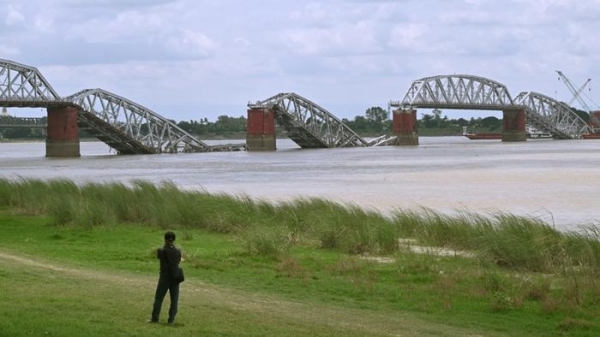
Image: View of the Ava Bridge near Sagaing, Myanmar, which collapsed during the March 2025 magnitude 7.7 earthquake. The bridge was built in 1934 and was the only bridge across the Irrawaddy river for more than 60 years after its construction (Credit: Photo by study coauthor Wang Yu)