

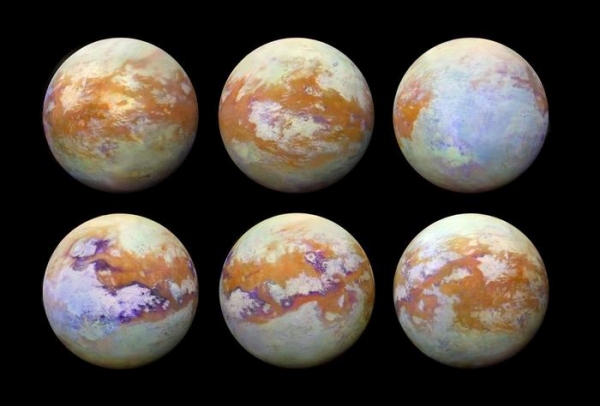
Careful reanalysis of data from more than a decade ago indicates that Saturn’s biggest moon, Titan, does not have a vast ocean beneath its icy surface, as suggested previously.
Careful reanalysis of data from more than a decade ago indicates that Saturn’s biggest moon, Titan, does not have a vast ocean beneath its icy surface, as suggested previously. Instead, a journey below the frozen exterior likely involves more ice giving way to slushy tunnels and pockets of meltwater near the rocky core.
Data from NASA’s Cassini mission to Saturn initially led researchers to suspect a large ocean composed of liquid water under the ice on Titan. However, when they modeled the moon with an ocean, the results didn’t match the physical properties described by the data. A fresh look yielded new — slushier — results. The findings could spark similar inquiries into other worlds in the solar system and help narrow the search for life on Titan.
“Instead of an open ocean like we have here on Earth, we’re probably looking at something more like Arctic sea ice or aquifers, which has implications for what type of life we might find, but also the availability of nutrients, energy and so on,” said Baptiste Journaux, a University of Washington assistant professor of Earth and space sciences.
The study, published Dec. 17 in Nature, was led by NASA with collaboration from Journaux and Ula Jones, a UW graduate student of Earth and space sciences in his lab.
Read More: University of Washington
Image: The six infrared images of Titan above were created by compiling data collected over the course of the Cassini mission. They depict how the surface of Titan looks beneath the foggy atmosphere, highlighting the variable surface of the moon. (Credit: NASA - https://science.nasa.gov/image-detail/amf-7c2a49e6-2a2d-4cac-ba34-9cdf257db3ec/)


