

The UC San Diego-led program joins forces with research programs across the world to improve forecasts of extreme weather events.
The UC San Diego-led program joins forces with research programs across the world to improve forecasts of extreme weather events.
Atmospheric rivers may be associated with wet winter storms on the West Coast of North America, but these ribbons of water vapor in the sky are a global phenomenon. They can end droughts or destroy homes with dangerous flooding, and they are projected to become more intense and destructive. Now, a new international effort will study and forecast these storms on a global scale.
Starting this year, the Atmospheric River Reconnaissance program (AR Recon), led by the Center for Western Weather and Water Extremes (CW3E) at UC San Diego’s Scripps Institution of Oceanography and the National Oceanic and Atmospheric Administration (NOAA), will coordinate flights to study atmospheric rivers across both the Pacific and Atlantic oceans. This expansion of AR Recon, which has studied atmospheric rivers using specially outfitted aircraft over the Pacific Ocean since 2016, is called the Global Atmospheric River and Reconnaissance Program (GARRP). This global program hopes to transform forecasts of extreme weather events and extend reliable predictions beyond the current one-week limit.
Read More: University of California – San Diego
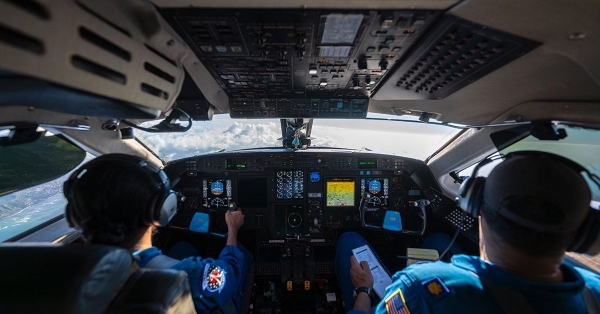
Image: Inside the cockpit of a NOAA Gulfstream IV during an Atmospheric River Reconnaissance mission in February 2025. (Image credit: Erik Jepsen/UC San Diego)


