

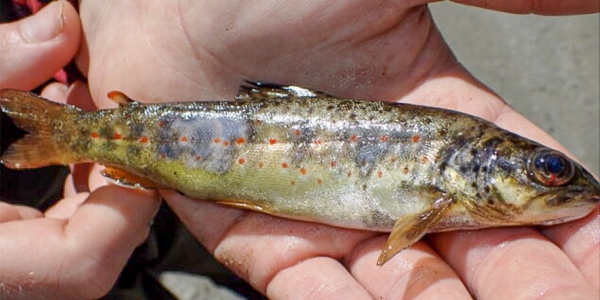
Hundreds of Norwegian hydropower plants threaten fish and bottom-dwelling animals by exposing them to water that is oversaturated with air.
Hundreds of Norwegian hydropower plants threaten fish and bottom-dwelling animals by exposing them to water that is oversaturated with air. The danger increases with wilder, wetter weather and more flooding. The solution may be to use sound in a new way.
Professor Ole Gunnar Dahlhaug and postdoctoral fellow Wolf Ludwig Kuhn at NTNU have three goals: To understand the problem of gas supersaturation at hydropower plants, to solve it, and to help correct mistakes made during Norway’s more than 100 years of hydropower production.
Hydropower: Only Partially Sustainable
“Hydropower is known as clean and green, but it turns out that it is neither completely clean nor completely sustainable. We have to try to solve this problem,” says Ole Gunnar Dahlhaug.
Read More: Norwegian University of Science and Technology
Image: This small trout was found in the Otra River, 20 km below one of Norway's largest power stations. It had all the signs of gas bladder disease: protruding eyes, bleeding, infection and wear and tear on the fins. (Credit: Photo: Ulrich Pulg, NORCE)


