

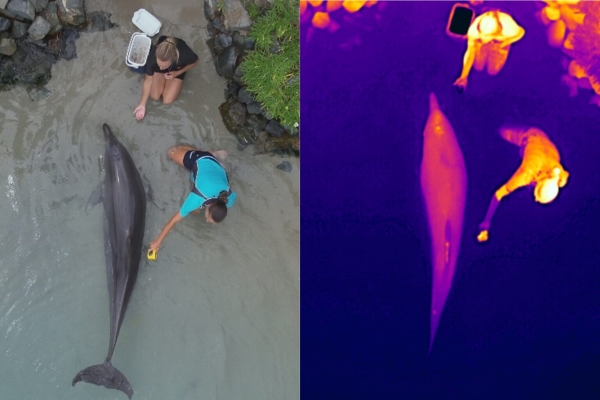
Australia’s beloved dolphin populations face growing pressures from environmental changes and human activity, increasing the need for reliable, accessible and non-invasive tools to monitor their health and support conservation and management.
Australia’s beloved dolphin populations face growing pressures from environmental changes and human activity, increasing the need for reliable, accessible and non-invasive tools to monitor their health and support conservation and management.
In a new study published in the Journal of Thermal Biology, marine mammal experts from Flinders University analysed more than 40,000 drone-based thermal images to test how accurately drones fitted with thermal cameras can measure dolphin surface temperature and respiration rates without the need for capture or invasive probes.
The research tested whether drones equipped with thermal cameras could reliably measure dolphin surface temperature and breathing rates
“Monitoring the health of dolphins is important for assessing environmental impacts and supporting conservation, but because they spend most of their lives underwater traditional health checks often require capture, restraint or invasive probes, which can be logistically challenging and potentially stressful for the animals,” says PhD candidate Charlie White, from the Cetacean Ecology, Behaviour and Evolution Lab (CEBEL) at Flinders University.
Read More: Flinders University
Image: Side-by-side comparison of a standard colour drone image (left) and a thermal image (right) during close-range reference measurement collection. Photo Credit: C White/CEBEL (Flinders University)


