

A research team led by Chalmers University of Technology, Sweden, have presented a new way to produce hydrogen gas without the scarce and expensive metal platinum.
A research team led by Chalmers University of Technology, Sweden, have presented a new way to produce hydrogen gas without the scarce and expensive metal platinum. Using sunlight, water and tiny particles of electrically conductive plastic, the researchers show how the hydrogen can be produced efficiently, sustainably and at low cost.
Hydrogen plays a key role in the global pursuit for renewable energy. Although its use produces only water as a by-product, significant challenges remain before hydrogen can be produced both on a large-scale and in an environmentally friendly way.
A major challenge is the use of the metal platinum as a co-catalyst when sunlight and water are used to produce hydrogen. The Earth’s reserves of platinum are limited, and extraction is associated with risks to both the environment and to human health. Moreover, the production is concentrated in only a few countries, for example South Africa and Russia.
In a new study, published in the scientific journal Advanced Materials, a research team led by Professor Ergang Wang at Chalmers, show how solar energy can be used to produce hydrogen gas efficiently – and completely without platinum.
Read More: Chalmers University of Technology
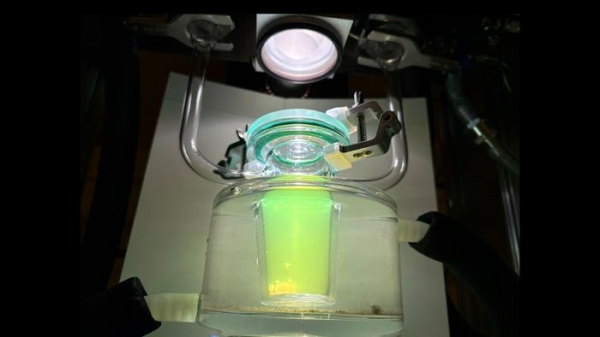
Image: A research breakthrough opens up for efficient hydrogen production from solar energy – without using the scarce metal platinum. In a reactor at a chemistry laboratory at Chalmers University of Technology, Sweden, bubbles of hydrogen gas can be easily seen with the naked eye as they form – showing that photocatalysis is happening efficiently. (Image Credit: Chalmers University of Technology | Mia Halleröd Palmgren)


