

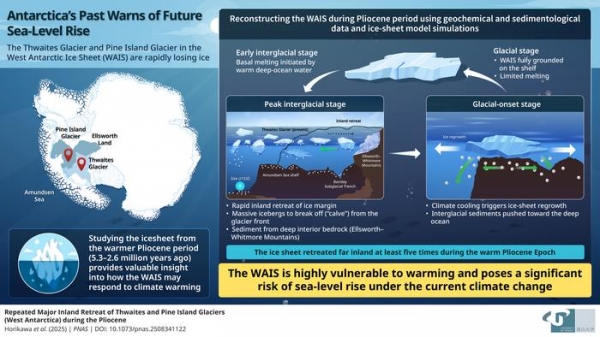
A record of repeated retreat of the West Antarctic Ice Sheet during the past warm climates has been identified by International Ocean Discovery Program (IODP) Expedition 379 Scientists.
A record of repeated retreat of the West Antarctic Ice Sheet during the past warm climates has been identified by International Ocean Discovery Program (IODP) Expedition 379 Scientists. By analyzing deep-sea sediments from the Amundsen Sea and tracing their geochemical signatures, the study shows that the ice sheet retreated far inland at least five times during the warm Pliocene Epoch. The findings highlight the ice sheet’s sensitivity to warming and its potential to drive future sea-level rise.
The Thwaites and Pine Island glaciers, located in the Amundsen Sea sector of the West Antarctic Ice Sheet (WAIS), are among the fastest-melting glaciers on Earth. Together, they are losing ice more rapidly than any other part of Antarctica, raising serious concerns about
the long-term stability of the ice sheet and its contribution to future sea-level rise.
To better understand the risks that warmer conditions pose to the WAIS, researchers are looking back to the Pliocene Epoch (5.3–2.58 million years ago), when global temperatures were about 3–4 °C higher than today and sea levels stood more than 15 meters higher, with melted ice from Antarctica contributing to much of that rise.
Now, examining a deep-sea sediment from this region, researchers from the IODP Exp379 Scientists, found that the WAIS margin retreated far inland at least five times during the Pliocene period.
Read More: University of Toyama
Image: By studying Pliocene sediments deposited when Earth was warmer than today, the researchers found that the West Antarctic Ice Sheet retreated far inland at least five times. These findings provide critical insight into how the ice sheet may respond to ongoing climate warming and the potential scale of future sea-level rise. (Image Credit: Professor Keiji Horikawa from the University of Toyama, Japan)


