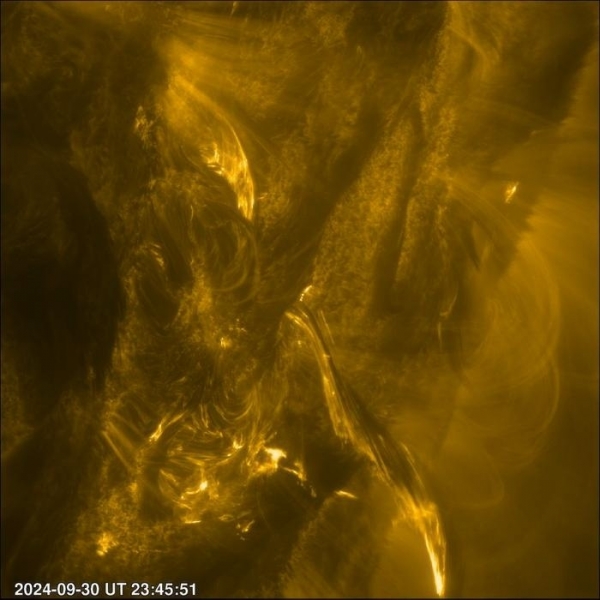
Just as avalanches on snowy mountains start with the movement of a small quantity of snow, the ESA-led Solar Orbiter spacecraft has discovered that a solar flare is triggered by initially weak disturbances that quickly become more violent.
Just as avalanches on snowy mountains start with the movement of a small quantity of snow, the ESA-led Solar Orbiter spacecraft has discovered that a solar flare is triggered by initially weak disturbances that quickly become more violent. This rapidly evolving process creates a ‘sky’ of raining plasma blobs that continue to fall even after the flare subsides.
The discovery was enabled by one of Solar Orbiter’s most detailed views of a large solar flare, observed during the spacecraft’s 30 September 2024 close approach to the Sun. It is described in a paper published today in Astronomy & Astrophysics.
Solar flares are powerful explosions on the Sun. They occur when energy stored in tangled magnetic fields is suddenly released through a process described as ‘reconnection’. In a matter of minutes, criss-crossing magnetic field lines of opposite direction break and then reconnect. The newly reconnected field lines can quickly heat up and accelerate million-degree plasma, and even high-energy particles, away from the reconnection site, potentially creating a solar flare.
Read More: European Space Agency
Image: A snapshot taken a second before a powerful solar flare was unleashed from the Sun, as seen in unprecedented detail by Solar Orbiter (Credit: ESA & NASA/Solar Orbiter/EUI Team)