

Newly identified methods to harness the properties of tungsten carbide could yield viable substitutes for precious metals like platinum.
Newly identified methods to harness the properties of tungsten carbide could yield viable substitutes for precious metals like platinum.
Important everyday products—from plastics to detergents—are made through chemical reactions that mostly use precious metals such as platinum as catalysts. Scientists have been searching for more sustainable, low-cost substitutes for years, and tungsten carbide—an Earth-abundant metal used commonly for industrial machinery, cutting tools, and chisels—is a promising candidate.
But tungsten carbide has properties that have limited its applications. Marc Porosoff, an associate professor in the University of Rochester’s Department of Chemical and Sustainability Engineering, and his collaborators recently achieved several key advancements to make tungsten carbide a more viable alternative to platinum in chemical reactions.
Read More: University of Rochester
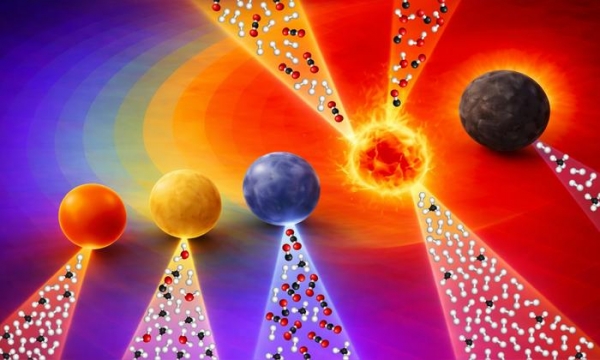
Image: The evolution of carburization (depicted by the spheres) under kinetic control (illustrated by the surface contours). The molecular beams represent gas evolution under synthesis conditions while the fiery sphere highlights the formation of the pure tungsten semi-carbide phase with additional molecular beams at the top to illustrate its catalytic performance. (Credit: Illustration by Sinhara M. H. D. Perera)


