

We’ve come a long way from the Old Farmer’s Almanac: These days, when farmers need to know about tomorrow’s weather — or next month’s weather — they can get a close-to-home forecast from Washington State University’s AgWeatherNet.
We’ve come a long way from the Old Farmer’s Almanac: These days, when farmers need to know about tomorrow’s weather — or next month’s weather — they can get a close-to-home forecast from Washington State University’s AgWeatherNet.
That system does more than predict temperatures and precipitation. Drawing on data from 370 public-private stations across the state, it uses machine learning to power tools that help growers predict wheat yields, anticipate problems with pests, protect against frost and high heat, schedule irrigation, and more.
As the amount of location-specific data grows, it will fuel even more refined microclimate forecasting — down to the level of an acre.
“It is happening now and we are improving it further,” said Lav Khot, the director of AgWeatherNet and a professor of precision agriculture in the Department of Biological Systems Engineering with a focus on agricultural automation. “That’s where AI comes in: How can we mine the information from this data and make better management decisions? It’s really changing the game.”
Read More: Washington State University
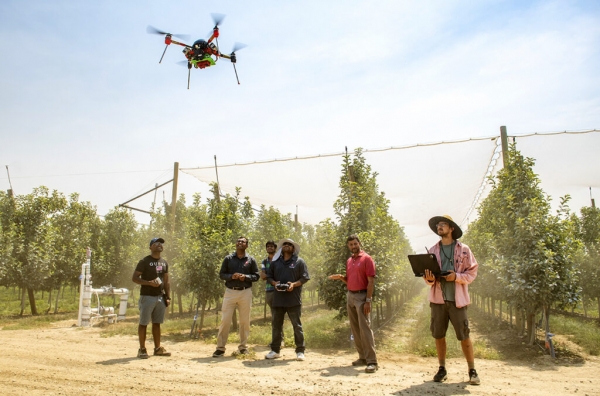
Image: WSU researchers use drones to gather data on farm conditions to help drive AI-assisted forecasting tools. WSU's leadership in AI for agriculture is reflected in its leadership of AgAID, a network of research institutions and industry partners (photo courtesy of WSU).


