

Plastic pollution has become a major global environmental concern as modern societies rely increasingly on plastic products.
Plastic pollution has become a major global environmental concern as modern societies rely increasingly on plastic products. Much of this plastic waste eventually reaches the ocean, with rivers acting as the main transport routes from urban, agricultural, and other landscapes, thereby affecting the lives of marine organisms. Over time, larger plastic items break down into smaller pieces known as microplastics (less than 5 millimeters) and mesoplastics (between 5 and 25 millimeters). These particles can spread through diverse ecosystems and are now found in many living organisms, including humans. To develop effective countermeasures, it is essential to accurately estimate how much plastic the rivers carry to the ocean.
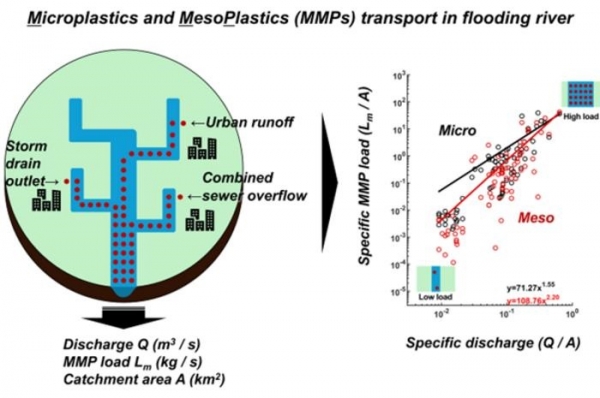
Many previous studies have examined microplastic and mesoplastic (MMP) concentrations in river water during normal, low-flow conditions. However, they have largely overlooked what happens during floods. Similar to suspended sediment (SS), large amounts of plastic are thought to be transported to the ocean during high-flow conditions, but how exactly MMP concentrations vary during flooding remains unclear. Moreover, few studies have examined the combined effects of urbanization and high flows.
Read More at: Tokyo University of Science
The findings of the study show that microplastic and mesoplastic concentration increases significantly during floods, and ignoring high-flow conditions can lead to a serious underestimation of annual plastic emissions from rivers to oceans. (Photo Credit: ssistant Professor Mamoru Tanaka from Tokyo University of Science, Japan)


