

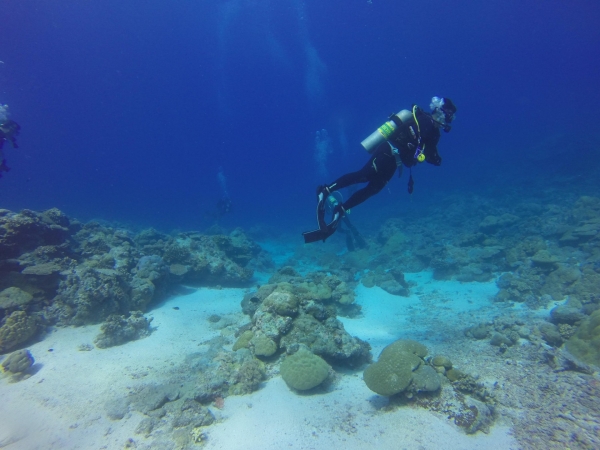
Corals living in coastal bays with strongly fluctuating temperatures and environmental conditions are better able to withstand heat and other stressors than their counterparts on more stable reefs.
Corals living in coastal bays with strongly fluctuating temperatures and environmental conditions are better able to withstand heat and other stressors than their counterparts on more stable reefs. This is shown by research conducted by marine biologist Sarah Solomon, whose work offers valuable insights into the mechanisms and trade-offs associated with the resilience of coral reefs in a rapidly changing climate. On Thursday 19 February, she will defend her PhD thesis at the University of Amsterdam.
Coral reefs are among the most biodiverse ecosystems on the planet and play a vital role in coastal protection, fisheries, and tourism. “They provide habitat for approximately 32% of all known marine species, despite occupying less than 0.1% of the ocean’s surface area,” Solomon explains.
Despite their importance, coral reefs are declining rapidly worldwide due to multiple threats, including climate change and local human pressures, such as pollution and excess nutrients in the water. “As the oceans warm, and marine heatwaves increase in frequency and severity, coral reefs are increasingly affected by large-scale bleaching events and mass mortality,” says Solomon.
Read More: Universiteit van Amsterdam
Photo Credit: arhnue via Pixabay


