Despite rare earth elements’ importance in manufacturing cell phones, magnets and a host of other consumer and commercial electronics, the lack of a sustainable, environmentally friendly approach to obtaining these metals has led to a global shortage, according to Amir Sheikhi, associate professor of chemical engineering.
Despite rare earth elements’ importance in manufacturing cell phones, magnets and a host of other consumer and commercial electronics, the lack of a sustainable, environmentally friendly approach to obtaining these metals has led to a global shortage, according to Amir Sheikhi, associate professor of chemical engineering.
Sheikhi is the principal investigator on a paper, recently published in Advanced Functional Materials, that proposes a novel technology of isolating and recovering dysprosium, a rare earth element used to manufacture semiconductors, engines, generators and more. The team used cellulose — an abundant and critical building block found in the walls of plant cells — to selectively separate dysprosium from other elements. According to the researchers, the approach is more environmentally friendly, as well as more sustainable and efficient than other commercial approaches.
The 17 metals classified as rare earth elements can be further categorized as heavy or light depending on their chemical makeup, according to Sheikhi, who also holds the title of Dorothy Foehr Huck and J. Lloyd Huck Early Career Chair in Biomaterials and Regenerative Engineering. His team had previously used cellulose-based compounds to successfully salvage neodymium, a light rare earth element used to develop powerful magnets, from e-waste like recycled circuit boards from computers.
Read More: Penn State University
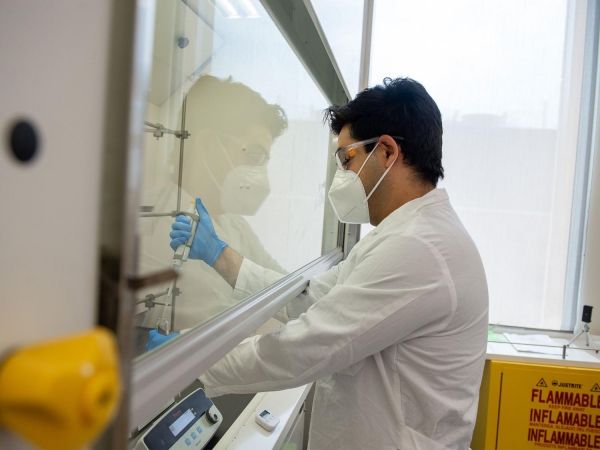
Using a material derived from plants, researchers at Penn State have devised a renewable and sustainable approach to separating and recovering dysprosium, a heavy rare earth element used in semiconductor manufacturing and more. (Photo Credit: Kate Myers / Penn State. Creative Commons)