

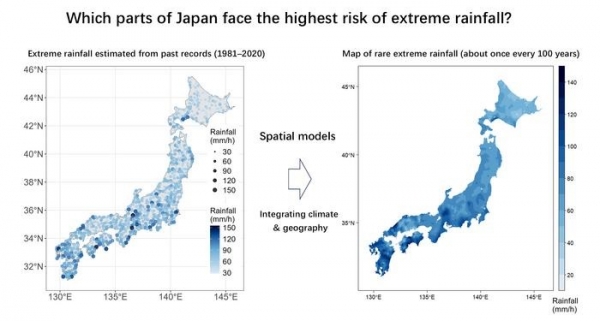
Japan is an archipelago with diverse climate zones and complex topography that is prone to heavy rain and flooding.
Japan is an archipelago with diverse climate zones and complex topography that is prone to heavy rain and flooding. Add the growing effects of global warming, these disaster risks are heightened with an increased frequency and intensity of extreme precipitation events. Thus, predicting when and where these events might strike is crucial for future-proofing vulnerable infrastructure, especially in rural areas.
However, current systems for tracking comprehensive weather data are primarily stationed around urban areas, presenting a significant statistical gap across large swathes of Japan. Proper data analysis methods to overcome this and provide accurate predictions to assist in future disaster preparedness further pose a challenge. In related fields, there is debate regarding the traditional kriging method used for spatial predictions, as it causes the underestimation of extreme values, and the high computational load of Bayesian hierarchical models based on the Markov Chain Monte Carlo (MCMC) method. As a plausible alternative, the Integrated Nested Laplace Approximation - Stochastic Partial Differential Equation (INLA-SPDE) method is positioned as an efficient alternative that overcomes these shortcomings and is widely used in environmental and climate research. However, its application to spatiotemporal analysis in complex topographies like Japan is limited.
Read More at: Osaka Metropolitan University
Using weather data from 1981–2020, statistical methods analyzed data to predict extreme rainfall in the next hundred years. (Photo Credit: Osaka Metropolitan University)


