

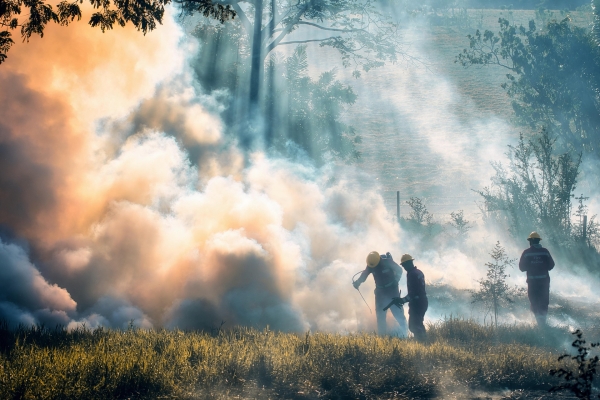
How can scientists better assess the effects of a warming climate on wildfire behavior, fire risk, and long-term fire trends?
How can scientists better assess the effects of a warming climate on wildfire behavior, fire risk, and long-term fire trends? A new review co-authored by Yale School of the Environment senior science researcher Jennifer Marlon outlines how climate change is reshaping wildfire patterns worldwide. The review, published in Science Advances, also details why understanding these shifts is essential for forecasting future risks.
“We’re seeing landscape fires increasingly threaten human health and property in ways that demand urgent attention,” Marlon said.
The paper, “Gazing into the flames: A guide to assessing the impacts of climate change on landscape fire,” brings together research from wildfire scientists across Australia, Europe, Canada, and the United States to focus on “the art and science” of projecting climate change impacts on landscape fire, including how fire’s drivers and impacts are modeled and how projections of the climate system are developed. Drawing on decades of fire research, satellite observations, climate model projections, and landscape fire modeling, the authors argue that traditional approaches fall short unless they integrate ecological, climatic, and human drivers.
Read More: Yale University
Photo Credit: RonaldPlett via Pixabay


