More than 350,000 chemicals are used worldwide, and many find their way into the ocean through plastic pollution.
More than 350,000 chemicals are used worldwide, and many find their way into the ocean through plastic pollution. As plastics accumulate in coastal waters, they continuously leach bioactive additives that can interfere with the chemical cues marine animals rely on to find food, avoid predators, choose habitats and communicate.
One such chemical, oleamide, is an industrial lubricant in plastics like polyethylene and polypropylene. As these plastics degrade, oleamide seeps into the water. But it’s not just industrial: oleamide is naturally produced by many organisms and influences sleep in mammals, acts as a pheromone in some marine species, and closely resembles oleic acid – a cue tied to death and scavenging in arthropods like crabs. By mimicking natural signals, oleamide may quietly alter how marine life senses food and interacts with one another.
To understand these effects, Florida Atlantic University researchers studied how plastic-derived oleamide influences predator-prey behavior. They focused on a common South Florida octopus (Octopus vulgaris), a key mesopredator, and observed its responses to four widespread prey: hermit crabs, free-living crabs, snails and clams.
Read more at: Florida Atlantic University
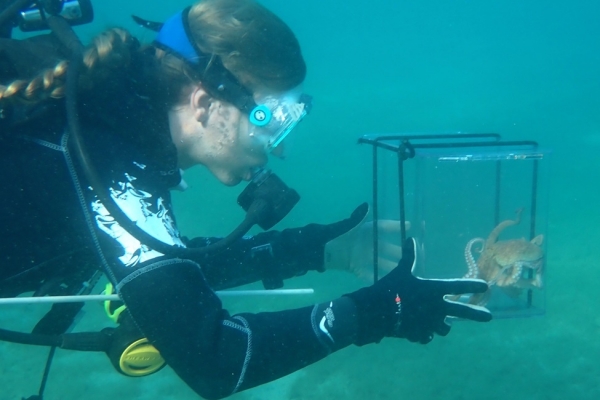
Madelyn A. Hair returns an octopus to its capture site after participating in the study. (Photo Credit: Florida Atlantic University)