

Plowing, or tilling, is an age-old agricultural practice that readies the soil for planting by turning over the top layer to expose fresh earth.
Plowing, or tilling, is an age-old agricultural practice that readies the soil for planting by turning over the top layer to expose fresh earth. The method — intended to improve water and nutrient circulation — remains popular today, but concerns about soil degradation have prompted some to return to regenerative methods that disturb the soil less.
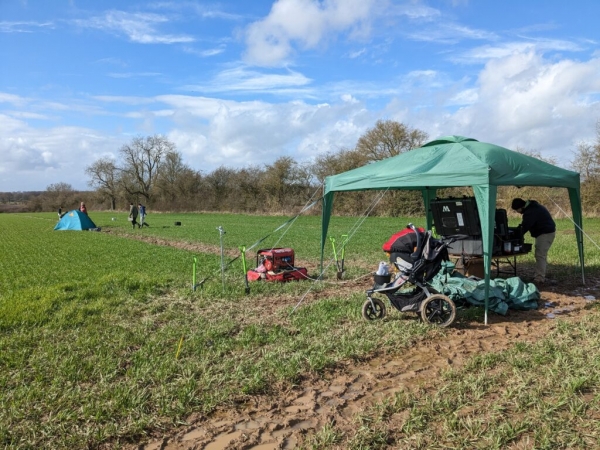
In a new study, a team led by University of Washington researchers examined the impact of tilling on soil moisture and water retention using methods originally designed for monitoring earthquakes. Researchers placed fiber optic cables alongside fields at an experimental farm in the United Kingdom and recorded ground motion from plots receiving different amounts of tillage and compaction from tractor tires pulling farm equipment.
The study, published March 19 in Science, shows that tilling and compaction disrupt intricate capillary networks within the soil that give it a natural sponge-like quality.
“This study offers a clear explanation for why the process of tillage, one of humanity’s oldest agricultural activities, changes the structure of soil in ways that affect how it soaks up water,” said co-author David Montgomery, a UW professor of Earth and space sciences.
Read More: University of Washington
Image: A plot of experimental land at Joe Collins’ Field near Harper Adams University, where University of Washington researchers travelled to collaborate on an agroseismology experiment examining the impact of tilling on soil moisture. Photo: Marine Denolle/University of Washington


