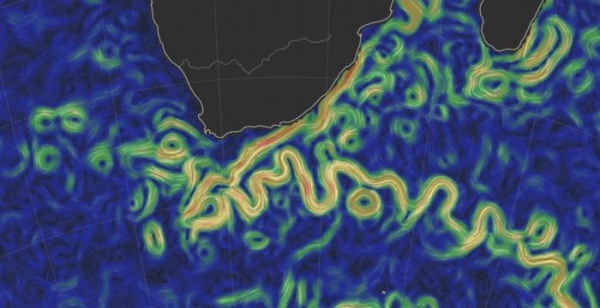
Lisa Beal, a professor of ocean sciences at the University of Miami Rosenstiel School of Marine, Atmospheric, and Earth Science, collaborated with South African researchers to study the Agulhas Current, a fast and narrow western boundary current flowing poleward along the southeast coast of Africa.
Lisa Beal, a professor of ocean sciences at the University of Miami Rosenstiel School of Marine, Atmospheric, and Earth Science, collaborated with South African researchers to study the Agulhas Current, a fast and narrow western boundary current flowing poleward along the southeast coast of Africa. Over a two-year period, they gathered high-resolution mooring data, recording hourly measurements of velocity, temperature, and salinity throughout the entire depth and width of the current.
The dataset launched more than a decade of research, with foundational work led at the Rosenstiel School and now advanced through sustained collaboration with Kathryn Gunn at the University of Southampton in the United Kingdom. Gunn and Beal use this dataset to show that increasing eddy activity is reshaping the Agulhas Current and intensifying adjacent coastal temperature extremes. Their findings, published in a new study in the journal Nature Climate Change, identify small frontal instabilities, about 10 kilometers across, along with larger, iconic meanders of the current, that transfer heat, salt, and nutrients between the open ocean and coastal environments.
“More eddy activity is accelerating surface warming in the Agulhas, while simultaneously enhancing hidden upwelling that cools deeper waters,” said Beal, the study’s senior author. “This combination—along with the onshore encroachment also driven by eddies—will create more extreme conditions in shelf seas in the future, potentially placing significant strain on coastal ecosystems.”
Read more at: University of Miami Rosenstiel School of Marine, Atmospheric, and Earth Science
Ocean currents on Feb 11, 2018 from OSCAR v2.0, distributed by NASA JPL, generated by Earth and Space Research, and visualized by earth.nullschool.net. (Photo Credit: Earth and Space Research, and visualized by earth.nullschool.net.)