

Researchers at the University of Zurich have analyzed the genome of bacteria living in Lake Zurich to conclude that microbes employ two different strategies to colonize new habitats.
Researchers at the University of Zurich have analyzed the genome of bacteria living in Lake Zurich to conclude that microbes employ two different strategies to colonize new habitats. Some acquire new traits, as expected – but others reduce the size of their genome and lose some functions in order to successfully move to a new home.
Bacteria are tiny – and incredibly old: they were among the first life forms to emerge on our planet around four billion years ago. Since then, they have “infected the entire Earth,” says Adrian-Stefan Andrei, head of a research group at the Department of Plant and Microbial Biology at the University of Zurich’s Limnological Station. “They swim in the oceans, are found deep in the soil as well as in and on other living organisms – and some of them even float high up in the atmosphere.”
Read more at: University of Zurich
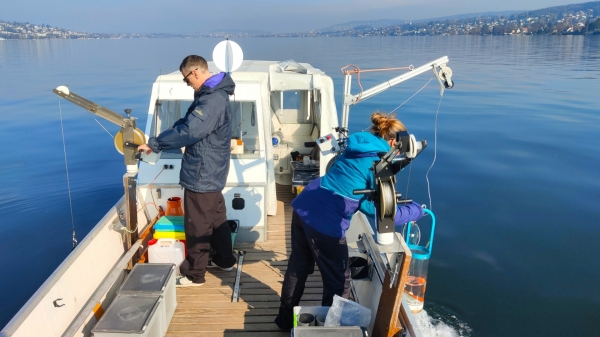
UZH researchers from the Limnological Station conducting microbial monitoring on Lake Zurich during a field campaign: Water samples are collected using specialized equipment for downstream ecological and molecular analyses. (Photo Credit: Gianna Dirren-Pitsch, UZH)


