

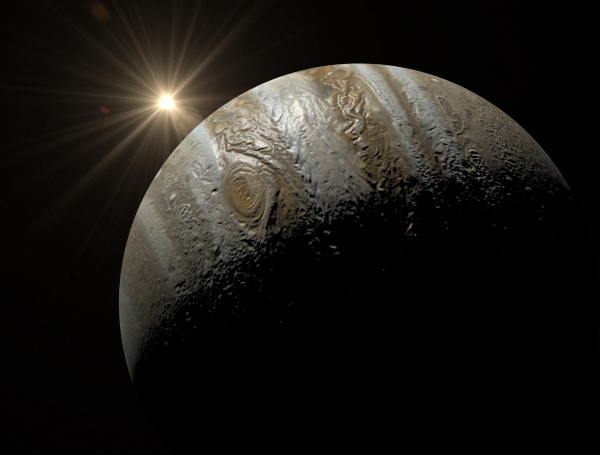
A team of astronomers led by Elisabeth Matthews at the Max Planck Institute for Astronomy (MPIA) has made a discovery that highlights the limits of most current models of exoplanet atmospheres: water-ice clouds on a distant Jupiter-like exoplanet called Epsilon Indi Ab.
A team of astronomers led by Elisabeth Matthews at the Max Planck Institute for Astronomy (MPIA) has made a discovery that highlights the limits of most current models of exoplanet atmospheres: water-ice clouds on a distant Jupiter-like exoplanet called Epsilon Indi Ab. The way the observations were made has broader implications for exoplanet research: as an interesting immediate step on the path towards eventually finding and characterizing an Earth-analogue exoplanet.
Step by Step Towards a Second Earth
Exoplanet research has an ambitious long-term goal: at some time within the next few decades, astronomers hope to be able to detect traces of life on an exoplanet. On the path towards that goal, exoplanet research has gone through several stages. In the first stage of research, from 1995 to about 2022, the main focus of exoplanet researchers was on detecting more and more exoplanets, using indirect methods that gave them information about the masses of some exoplanets, the diameters of others, and in some cases both mass and diameter.
When the James Webb Space Telescope (JWST) began operating in earnest in 2022, exoplanet research entered a second stage: High-quality, detailed information about the atmospheres of many exoplanets became available for a considerable number of planets, and researchers began to reconstruct the properties of such atmospheres in some detail. This is still at least one stage removed from realistic searches for life on exoplanets, which are expected to require the next generation of space telescopes.
Read More: Max Planck Institute for Astronomy
Photo Credit: TBIT via Pixabay


