

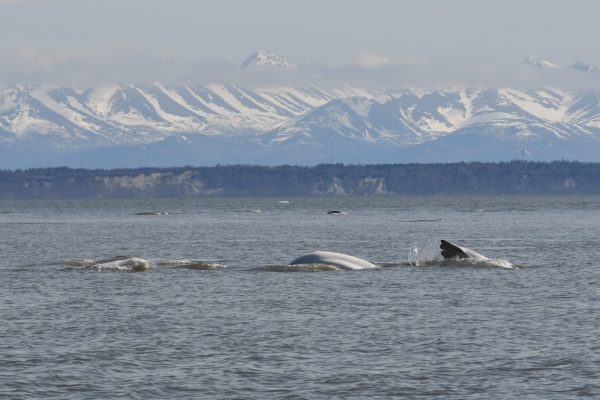
Alaska’s Cook Inlet was home to nearly 1,300 beluga whales in the late 1970s, but today the population hovers around 300.
Alaska’s Cook Inlet was home to nearly 1,300 beluga whales in the late 1970s, but today the population hovers around 300. Despite almost two decades of recovery work, the whales aren’t bouncing back. The Cook Inlet belugas are likely struggling under multiple pressures, including increasing human noise. Researchers are working on deciphering whale-whale communication to better account for the impact of noise on this vulnerable population.
In a new study, University of Washington scientists eavesdropped on Cook Inlet belugas, recording more than 1,700 calls representing 21 different behavioral encounters. This work builds on a 2023 study showing that noise from commercial shipping, the primary industry in the region, masks common beluga calls. Although many marine mammals rely more on sound than sight, our understanding of acoustic communication among these animals is limited.
Beluga whales use vocalizations to socialize, stick together and avoid danger. The new study, published May 7 in Behavioral Ecology and Sociobiology, investigated the behavioral, social and environmental contexts in which the whales produce various calls.
Read More at: University of Washington
Cook Inlet belugas swimming in northern Cook Inlet, near Anchorage, Alaska. (Photo Credit: Arial Brewer)


