

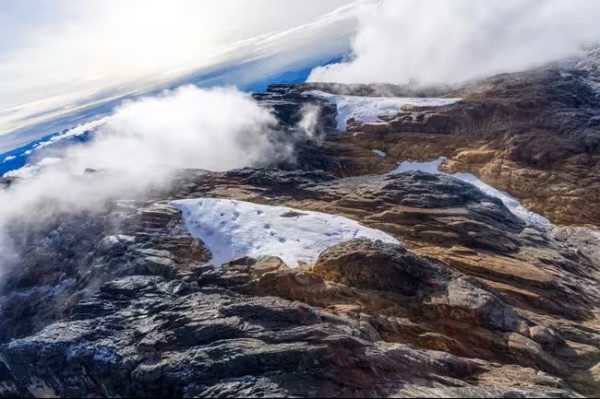
Asia’s last tropical glaciers can be found near Puncak Jaya, Papua, the highest peak in Southeast Asia.
Asia’s last tropical glaciers can be found near Puncak Jaya, Papua, the highest peak in Southeast Asia. But it is unlikely that they will survive until the end of this decade. Over the past 44 years, the peak has lost 97% of its ice and four of its glaciers. Its remaining two glaciers, Carstensz and the East Northwall Firn glacier, are expected to disappear by 2030, adding Indonesia (alongside Venezuela and Slovenia) to the list of countries that have lost all of their glaciers.
The rise in global temperatures has directly contributed to global glacier melt. For Indonesia’s glaciers, this has been punctuated by El Niño years. The El Niño Southern Oscillation (ENSO) is a global climate phenomenon characterized by weather patterns that alternate between La Niña and El Niño conditions that affect each region of the planet in different ways. In Indonesia, El Niño conditions have dramatically increased glacier melt.
“For Papua, it becomes dry and warm during El Niño, which means less snow at high elevations and more melting. Both can be a death knell, especially to a small glacier,” said Mike Kaplan, a geologist at the Lamont-Doherty Earth Observatory, which is part of the Columbia Climate School. He studies the history of glaciers, climates and past landscapes. During the recent El Niño event between 2015 and 2016, Indonesia’s glaciers took a big hit.
Read More at: Columbia Climate School
Aerial view of remaining glacial ice on Puncak Jaya, Papua. (Photo Credit: BMKG)


